




President Yoweri Kaguta Museveni, has detailed Uganda’s monumental economic recovery journey since 1986, highlighting the nation’s growth from a depleted USD 3.9 billion economy to a robust USD 69.3 billion. Addressing the nation, the President called for accelerated industrialisation, aggressive value addition, and nationwide household wealth creation to anchor the country’s next phase of development.
Delivering his address virtually from State House, Entebbe, during Uganda’s 64th Independence Day celebrations, President Museveni emphasized that sustainable national transformation will depend on expanding manufacturing capacity, boosting household incomes, and ensuring full value retention from locally produced goods.

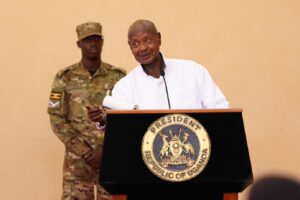
The 64th Independence anniversary was celebrated under the national theme: “Embracing Our Sovereignty with Hope and Visionary Leadership.”
Overcoming Historical Instability to Build a Resilient Economy
Reflecting on Uganda’s post-independence trajectory since October 9, 1962, President Museveni observed that 24 critical years were lost to political instability, civil conflict, and severe economic collapse prior to the National Resistance Movement (NRM) government taking power in 1986.
“First of all, I congratulate all Ugandans on this occasion of 64 years of Independence,” President Museveni stated. “Of those 64 years, some of the years were wasted between 1962 and 1986. We had 24 years of conflict and decline and fighting.”
The President recalled that by 1986, the national economy had shrunk to a mere USD 3.9 billion. In response, the NRM administration implemented a phased macro-economic recovery and stabilization strategy that successfully reconstructed and expanded the country’s productive base.
Driven by deliberate industrial policy, value addition, the imminent commercial production of oil, and the exponential growth of emerging sectors, the President projected that Uganda’s economy will reach approximately USD 74 billion by June 2027.
Critiquing historical structural challenges, the President explained that inherited colonial economic frameworks intentionally restricted Uganda to a narrow enclave economy dependent on raw agricultural and commodity exports. This design effectively excluded the majority of the population from the formal cash economy, a vulnerability the NRM government continues to systematically rectify through commercialized agriculture and value-added manufacturing.