

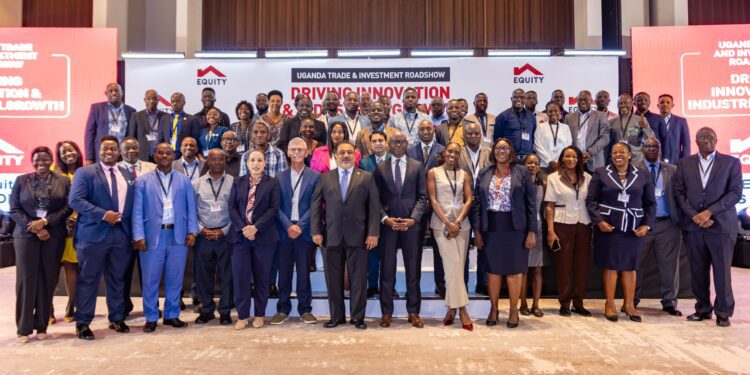
Minister of Trade, Industry and Cooperatives, Sanjay Tanna,has urged business leaders to move beyond exporting raw materials to value addition.
Opening Equity Bank 2026 Uganda Trade and Investment forum where more than 150 business leaders, investors and policymakers from 10 countries gathered he named agro-processing, minerals, pharmaceuticals, textiles, leather, construction materials and ICT as sectors with room to grow.
Tanna has agitated for Made-in-Uganda promotion and supported micro, small and medium enterprises among his stated priorities and challenged Equity Bank to take its model outside the main towns.

“Equity Bank built its foundation by lifting micro-enterprises in Kenya; we invite them to replicate that same grassroots model in rural Uganda,” he said, asking the bank to deepen support for MSMEs through financial literacy, bookkeeping, access to finance and market linkages,”he stated.
Tanna however said government is prepared to work with financial institutions to lower the cost of capital and reduce barriers to investment.
He emphasised the need for Uganda to transform its productive capacity by promoting investment, manufacturing, value addition, innovation and exports. This focus is consistent with the Ministry’s broader mandate of promoting industrial development and an export-led private sector.
A major theme of the Minister’s address was the importance of value addition. He urged Uganda to move beyond exporting raw materials and instead process and manufacture products locally.

He identified several sectors with opportunities for *value addition*, including agriculture and agro-processing, minerals, pharmaceuticals, textiles and garments, leather, construction materials and ICT.
According to the Minister, adding value to locally produced resources can generate employment, increase household incomes, strengthen local businesses, expand the tax base and enable Uganda to earn more from international trade.
Uganda’s development plans similarly identify value addition as an important pathway to higher incomes, employment creation and industrial growth.
Minister Tanna also stressed the importance of attracting the right investments and creating an environment in which businesses can grow and remain competitive.

He noted that investors require *predictability, efficient institutions, reliable infrastructure and energy, skilled labour, access to finance and clear regulations*. These conditions, he argued, are essential for encouraging both domestic and international investors to establish and expand businesses in Uganda.
He further emphasised that Government has a responsibility to continuously improve the business and investment environment while maintaining constructive engagement with the private sector.
The Minister’s remarks highlighted the importance of collaboration between Government, investors, financial institutions, entrepreneurs and other private-sector players in driving Uganda’s economic transformation.
The Equity Bank Uganda Trade Mission provided a platform for these stakeholders to discuss practical opportunities for investment and economic development. Such Government-private-sector collaboration is also central to Uganda’s wider industrialisation strategy.

Minister Tanna’s message was clear: Uganda must move from exporting raw materials to producing higher-value goods and services locally. By investing in manufacturing, value addition, innovation and human capital, while creating a predictable and investor-friendly business environment, Uganda can create more jobs, strengthen local enterprises and expand its presence in regional and international markets.
His address therefore placed value addition, investment and private-sector participation at the heart of Uganda’s journey towards sustainable industrialisation and economic transformation.
Claver Serumaga, Executive Director of Equity Bank Uganda, said the bank’s role extended beyond lending to connecting businesses with markets, technology and partners.
“Uganda does not lack opportunity; what we need is to connect that opportunity to the right capital, markets, technology and partnerships,” he said.
Mahvish Malik, Equity Group’s Associate Director of Trade Relations, said the missions were built to move companies from discussing markets to meeting counterparties directly, through government engagements, sector visits and market linkages.
