







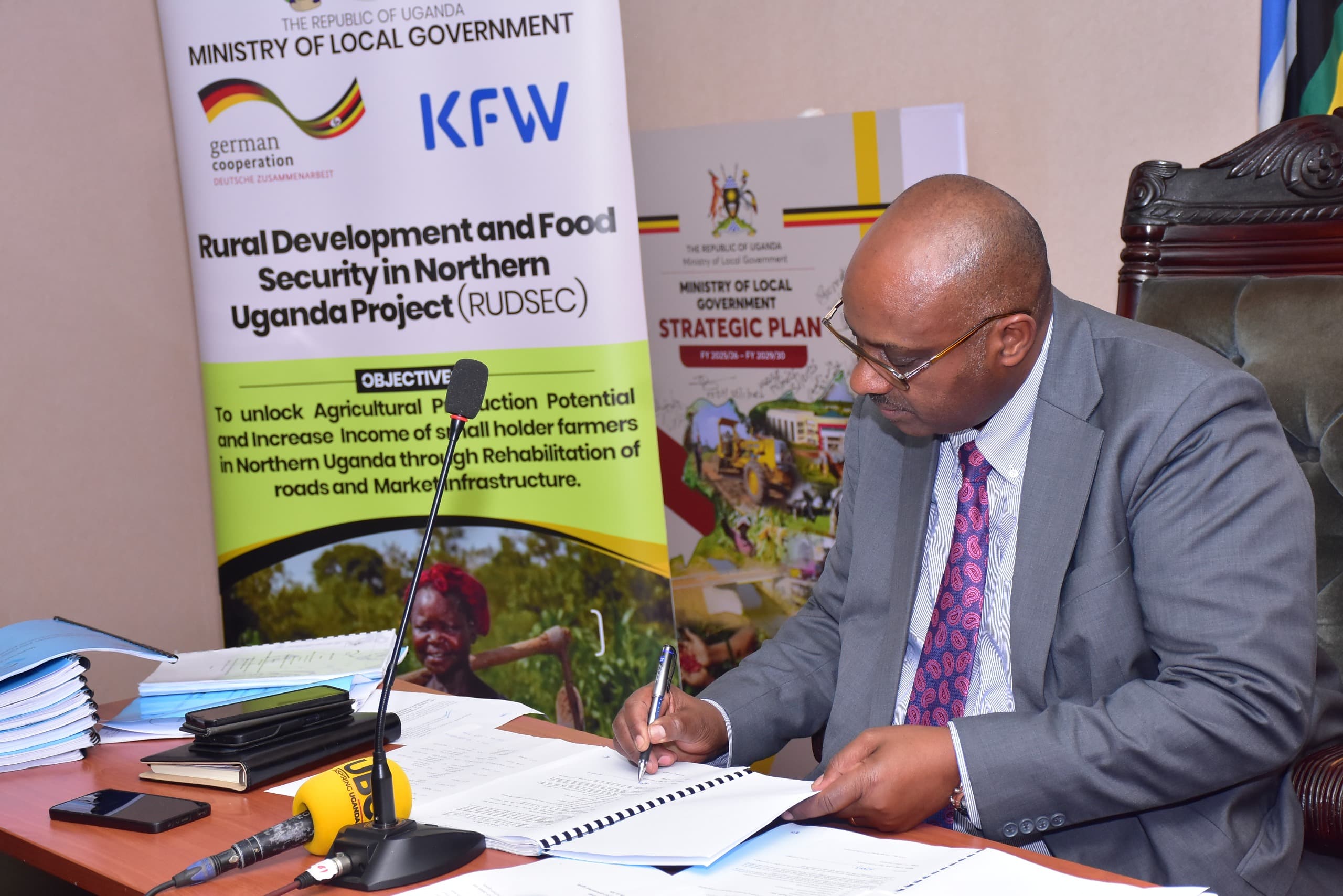
The Permanent Secretary Ministry of Local Government, Mr Ben Kumumanya, has signed contracts for the rehabilitation of 139 kilometres of district and community access roads across nine districts under the Rural Development for Food Security in Northern Uganda (RUDSEC) Project, marking a major investment in rural infrastructure aimed at accelerating agricultural production, improving food security and stimulating local economic development.
The strategic road rehabilitation programme is expected to improve access to markets, strengthen local government service delivery and increase household incomes by facilitating the efficient movement of people, agricultural produce and essential services.
Construction is scheduled to commence next week following the official handover of project sites to the successful contractors.


The project will benefit the districts of Lamwo, Agago, Pader, Dokolo, Lira, Oyam, Serere, Soroti and Kaberamaido, reaffirming the Government’s commitment to using rural infrastructure as a catalyst for socio-economic transformation.
Speaking during the contract signing ceremony held on Wednesday, July 8, 2026, at the Ministry of Local Government headquarters in Kampala, Mr Kumumanya described road infrastructure as one of the most critical drivers of Uganda’s development agenda.
“Industrialisation is central to Uganda’s journey towards middle-income status. That transformation begins with motorability and accessibility through roads, which facilitate trade, service delivery and other development activities,” Mr Kumumanya said.
He noted that well-maintained community access roads play a vital role in reducing transport costs, improving market access, increasing agricultural productivity and ensuring government services reach even the most remote communities.


The rehabilitation programme will cover Agago–Kalongo–Lomoi Road (Section A) measuring 15 kilometres, Agago–Kalongo–Lomoi Road (Section B) covering 14.9 kilometres, Lamwo–Corner Ogwec–Tenten Road stretching 21.6 kilometres, and Puranga–Ogonyo–Achola Stream Road in Pader District measuring 18 kilometres.
Other roads earmarked for rehabilitation include the Agweng–Barlonyo and Akano–Lwala roads in Lira District, covering a combined 16.3 kilometres; Alwimac–Awiri–Asalim Road in Dokolo District measuring 12.7 kilometres; Ochero–Bugoi Road in Kaberamaido District stretching 12.8 kilometres; Atirir–Orungo Border Road in Soroti District covering 13.5 kilometres; and the Serere Upper Shops–Akoboi and Kamod–Otimong–Akobi roads in Serere District, measuring a combined 14.9 kilometres.
According to the Ministry, the RUDSEC Project extends beyond road construction. It is a strategic investment intended to strengthen decentralisation, improve local government performance, stimulate rural enterprise and enhance the livelihoods of farming communities across Northern and Eastern Uganda.


The improved road network is expected to enable farmers to transport produce more efficiently, reduce post-harvest losses, attract private investment into rural areas and improve access to schools, health facilities, trading centres and other essential public services.
Kumumanya urged contractors to execute the works with professionalism, transparency and integrity, stressing that public infrastructure projects must deliver lasting value for citizens.

He also called on contractors to work closely with district local governments, prioritise local labour where possible and strictly observe environmental protection measures throughout the implementation period.“We are investing in roads because they are engines of development. When roads improve, agriculture grows, businesses expand, service delivery becomes more efficient and communities become more productive. We therefore expect quality work delivered on schedule and in accordance with the required standards,” he said.
The Rural Development for Food Security in Northern Uganda (RUDSEC) Project is jointly implemented by the Ministry of Local Government with financial support from the Government of Uganda and the Government of Germany through KfW Development Bank. The initiative seeks to improve food security and increase agricultural incomes among smallholder farmers by investing in rural infrastructure that connects communities to markets and broader economic opportunities.


