

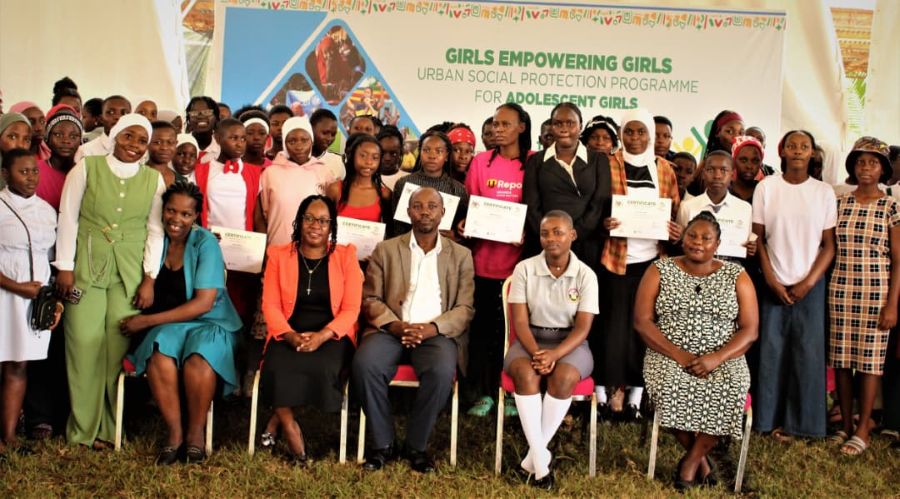
Kampala Capital City Authority (KCCA) in partnership with UNICEF have supported more than 4,000 vulnerable girls from dropping out of school through a combined model of cash transfers and mentorship, officials have revealed.
The Kampala Capital City Authority (KCCA) and UNICEF officially launched the Girls Empowering Girls (GEG) mentorship and cash transfer programme in 2019 with funding from Belgium tackling high school dropout rates and social risks affecting adolescent girls in urban communities. The initiative provided social protection to vulnerable in-school and out-of-school adolescent girls in Kampala to help them transition safely into adulthood.
Roughly 28% of girls in rural areas drop out, with high poverty, early marriage, pregnancy, and lack of menstrual hygiene management cited as key factors.
. KCCA Executive Director Sharifah Buzeki described the intervention as transformative, emphasizing the importance of integrating education, social protection and economic empowerment.
“We have learned that empowering girls requires a multidimensional approach,” Buzeki said, adding that lessons from the initiative will inform future city strategies.
she noted that under the program, shs2.6 billion was disbursed to vulnerable households, helping to stabilize families and keep girls in school and implemented by Trailblazers Mentoring Foundation Uganda and Uganda Youth Development Link, the project targeted high-risk groups including teenage mothers, girls with disabilities and refugees.
Beneficiaries and parents credited the mentorship component as critical to the program’s success. Mentors created safe spaces where girls could openly discuss challenges, helping them build confidence and avoid negative influences.
Parents also received financial literacy training alongside monthly stipends to support household needs. Some caregivers reported using the funds to start small businesses, improving family incomes and sustaining children’s education.
A peer mentor, Diana Kamwada, noted that the transition from primary to secondary school remains a vulnerable stage for many girls, but mentorship and financial support helped address barriers such as access to basic necessities.
UNICEF Country Director Robin Nandi said 95 percent of girls who completed primary education under the program transitioned to secondary school. However, she highlighted that multidimensional child poverty in Uganda remains high at 44 percent.
The GEG model is now being expanded to 11 additional districts, including West Nile and Acholi, with support from the European Union, Iceland and the Netherlands. The expansion aims to reach at least 15,000 more girls.
Despite the program’s success, its closure in Kampala has raised concerns among stakeholders. Mentors and community leaders warned that some girls may struggle without continued support, urging parents and local authorities to sustain the progress achieved.
Program Coordinator Sheila Birungi Gandi said the initiative leaves behind a strong evidence base for future urban social protection programs, even as calls grow for its continuation.
She called for community involvement, noting that engaging parents and caregivers has been central to reducing dropout rates.
