






From a broken post-colonial cash-crop base to a projected $74 billion economic engine, President Yoweri Museveni outlines a five-phase blueprint to keep Uganda’s wealth at home.
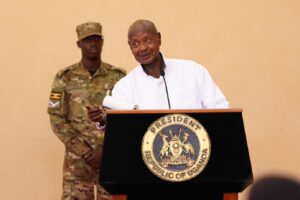
When Uganda marked its 64th Independence Day on October 9, 2026, the milestone arrived not with the traditional roar of physical crowds at a ceremonial ground, but via a virtual address broadcast from State House, Entebbe. Under the theme “Embracing Our Sovereignty With Hope and Visionary Leadership,” President Yoweri Kaguta Museveni used the occasion to look back over more than six decades of statehood—and to lay out a sharp, unapologetic math of national survival.
The core of his message was simple: political independence in 1962 was only the opening act. True sovereignty, he argued, requires economic muscle.
Museveni split Uganda’s post-colonial timeline into two starkly different chapters. Of the 64 years since the British lowered the Union Jack, he noted, nearly 24 were swallowed by civil strife, political misrule, and economic decay.

By the time the National Resistance Movement (NRM) took power in 1986, the damage was near-total. The national economy had shriveled to an estimated $3.9 billion. The narrow colonial economic structure—built around the classic “3Ts and 3Cs” of copper, cotton, coffee, tobacco, tourism, and tea—had fractured. Copper had collapsed, tourism was dead, tea was on life support, and Idi Amin’s regime had dismantled what little formal money economy remained.
From that $3.9 billion floor, the government embarked on a phased rescue mission:
Restoring basic output in broken sectors,Scaling up traditional agriculture and reviving volumes (such as coffee leaping from 3 million to 9 million bags, and tea soaring from 3 million to 60 million kilograms),Pushing farmers to treat everyday staples—milk, maize, beans, bananas, and fish—as commercial cash generators rather than mere subsistence,Halting the hemorrhage of shipping out raw materials and tapping into science, ICT, pharmaceuticals, and electric vehicle assembly.
Today, the economy stands at an estimated $69.3 billion, with projections pointing toward $74 billion by June 2027, supercharged by upcoming oil production and industrial scaling.
For Museveni, the symbol of Uganda’s unfinished economic war is a simple kilogram of coffee.
Exported raw, a kilo fetches roughly $2 on the international market. Roasted, ground, packaged, and marketed abroad, that same bean commands multiples more, with foreign corporations pocketing the lion’s share of the margin.
“This is the battle we are engaged in, value addition,” Museveni told the virtual audience.
It is a push that extends past coffee into cotton processing, milk packaging, fruit canning, and local manufacturing. Even the Uganda Prisons Service found itself caught up in this economic pivot, decorated during the celebrations for shifting into large-scale cotton farming and supplying locally made furniture to government offices instead of importing foreign goods.

While macro-level figures paint a story of exponential growth, the human reality remains a tightrope walk. Critics and economic analysts note that while the state eyes a grand $500 billion economy by 2040, everyday citizens continue to grapple with a sluggish shilling (trading near 4,060 to the dollar), high fuel excise duties, and stubborn transport bottlenecks—what Museveni colorfully dubbed the akatogo of urban traffic jams and heavy road-bound oil tankers. Logistics inefficiencies alone bleed an estimated $1 billion a year from the economy.
To bridge the gap between national GDP and kitchen tables, the government points to inclusion metrics: programs like Operation Wealth Creation and the Parish Development Model (PDM) have pushed the share of Ugandans operating inside the formal money economy from 32% up to 67%. Yet, that still leaves roughly a third of the population outside the commercial fold.
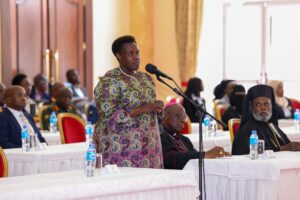
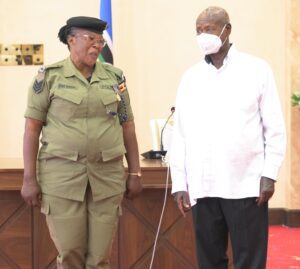
As Vice President Jessica Alupo and Minister for the Presidency Babirye Milly Babalanda echoed during the ceremonies, holding onto sovereignty means ensuring that rural dairy farmers in Ntungamo, smallholders in Rubirizi, and families in Kisozi see real money in their pockets.
The blueprint is set, the targets for June 2027 are locked in at $74 billion, and the rhetoric is sharp. Whether the average Ugandan household can feel that $74 billion horizon from the ground up remains the real test of the next 64 years.


