

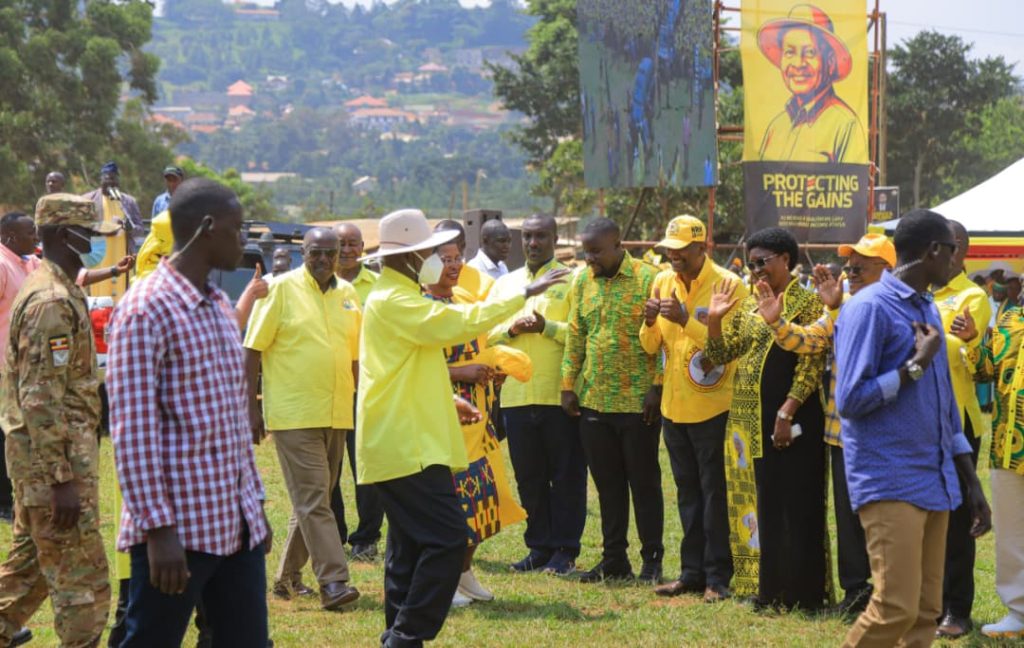
As runner up to his Campaign rally conclusion,President Yoweri Museveni has outlined wealth and job creation initiatives for Wakiso District, pledging increased funding and infrastructure developments in 2026/2031 term.
On infrastructure, the President assured residents of Entebbe and Wakiso District that government will expedite the completion of key road projects, including the Kisubi–Nakawuka–Mpigi road, the Nakawuka–Nateete road, and other ongoing works aimed at improving mobility and boosting business operations.
Addressing ardent supporters in Entebbe Museveni noted that Wakiso District, due to its fast-growing population and strategic location, has immense potential to harness wealth and employment opportunities across these sectors.

He urged residents to take advantage of existing government programs, emphasizing that the NRM government has already laid a strong foundation that employs millions of Ugandans nationwide.
He cautioned voters against what he described as opportunistic opposition politicians who, according to him, frustrate development programs, urging the electorate to vote for NRM flag bearers to ease implementation and supervision of government initiatives.
First Lady and Minister for Education and Sports, Maama Janet Kataaha Museveni, attributed the district’s development gains to the NRM’s strategic focus on peace and stability, reminding residents of how far Uganda has progressed under the party’s leadership.
NRM First National Vice Chairperson, Alhaji Moses Kigongo, called on party members in Wakiso and Entebbe to intensify grassroots mobilization for a decisive victory in the upcoming elections, while emphasizing discipline and mutual respect during and after the campaign period.

NRM Second National Vice Chairperson (Female), Anita Among, outlined additional development projects underway in Wakiso District, including the Shs35 billion Lubugumu–Busabala road, the Shs15.5 billion Kitoolo–Kawuku road, and the Shs23 billion Entebbe–Nakiwogo road and bridge project. She also cited the 72-kilometre Mpigi–Nakawuka–Nateete road and the second phase of Entebbe International Airport expansion, which she said has created numerous job opportunities for residents. Among also proposed the establishment of a dedicated youth wealth fund.
Among criticized opposition politicians in Wakiso for allegedly frustrating resettlement efforts for victims of the Kiteezi garbage landslide, claiming that political interference hindered earlier government interventions. She urged voters to support NRM candidates, whom she described as better positioned to deliver meaningful development.

Yoweri Kaguta Museveni has been Uganda’s President since 1986, coming to power after leading a guerrilla war against Milton Obote’s government, ending decades of conflict. He’s credited with bringing stability, economic growth, improved infrastructure (roads, electricity), better health/education access (reduced infant mortality, higher literacy), and regional peace efforts, though his long rule faces criticism over human rights, political opposition, and power consolidation. He remains a significant figure in African politics, focusing on development and unit
Key Aspects of His Rule:
Since taking power in 1986, Uganda’s National Resistance Movement (NRM) has registered major achievements including restoring peace, fostering national reconciliation, stabilizing the economy from ruin, and significant infrastructure development (roads, electricity, schools, hospitals), alongside initiatives like free education (Universal Primary/Secondary Education) and programs such as the Parish Development Model (PDM) to drive wealth creation, though implementation.
Museveni established a broad-based government that as ended civil wars (like the LRA insurgency in the north), and prioritized national unity and development.
He is active in East African integration and a proponent of African self-sufficiency