


The Chairperson of Uganda Human Rights Commission (UHRC) Mariam Wangadya has welcomed a team from the East Africa Community to Uganda to observe Uganda 2026 elections
“We strongly believe that your observer mission will provide meaningful recommendations not just for us but for the region as a whole. With Rwanda having had elections in 2024, Tanzania this year 2025 and Uganda early next year and Kenya in 2027, political and civil rights have been at the fore in the region,”she noted.
Wangadya said uganda’s political environment is active with civic space is dynamic.
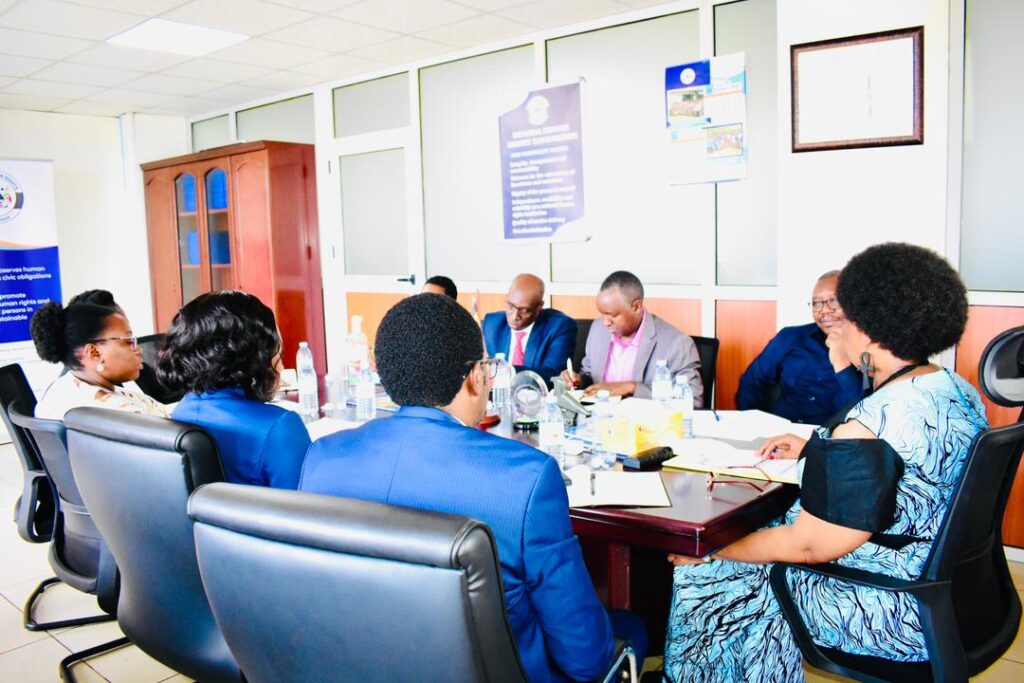
“The institutional environment is stabilizing, and the human rights context is encouraging, but still demands careful, professional assessment,”she stressed.
As the national human rights institution established under Article 51 of the Constitution, UHRC is mandated to monitor, investigate, and report on the state of human rights in all processes, including elections. This mandate extends before, during, and after elections. It is anchored in the Constitution of the Republic of Uganda, 1995 and guided by the Paris Principles and regional human rights standards.
According to Wagandya for the past 18 months, since the Electoral Commission released its electoral roadmap, UHRC has maintained continuous election monitoring, generating evidence-based assessments from every part of the country.
However in preparations for elections UHRC has completed a nationwide hotspot-mapping exercise to identify districts most vulnerable to election related tension.

“This risk map now guides our deployment strategy, our early-warning alerts, and our engagements with national and regional institutions (including yourselves) on preventative action to safeguard and ensure respect of human rights,”she said.
The Chairperson further noted that UHRC is in constant dialogue with Uganda’s security agencies to maintain overall national stability.
UHRC has convened a series of closed-door engagements with heads of security agencies – across the country. These discussions are high-level, technical, candid, and solution-oriented. They focus on proportionality, legality, crowd management, and the rights-based policing framework required during elections. I must say, that these engagements have significantly strengthened command-level guidance.
The Commission, working with the National Initiative for Civic Education in Uganda (NICE-UG), has carried out civic education activities focused on rights, responsibilities, and non-violence.

“We have trained community structures to reinforce peace messaging. Early this month, we held a joint national press appeal with the Electoral Commission, the Uganda Communications Commission (UCC), security agencies, civil society, religious leaders and traditional leaders to call for calm and lawful conduct at the height of campaigns.
UHRC has also engaged top leadership representatives from the various political parties in Uganda, the media, the youths – among others to affirm institutional rights and responsibilities in promoting, protecting and safeguarding human rights in the 2026 general election.
The Commission has mobilized funds and is preparing earnestly for the elections come January 2026. The relevant procurements such as vehicles and all other necessities are in the last stages of procurement. In doing all this, our aim is to ensure that human rights are safeguarded in the election.
UHRC has also perationalized a Human Rights Election Situation Room. This facility will:
- coordinate real-time monitoring from all UHRC regional offices;
- receive and analyze complaints from the public;
- track human rights incidents;
- support rapid-verification teams; and,
- generate periodic analytical briefs.
“As the Electoral Commission continues to prepare, we also continue to provide independent oversight and advice. The Electoral Commission initiated key pre-polling preparations. These include ballot-printing, recruitment of temporary staff, training of presiding officers, and readiness checks for Biometric Voter Verification Kits,”she revealed
“UHRC will be available to serve your Election Observation Mission as: the technical anchor, the information reference point, the early-warning partner, and the institutional bridge between state agencies and other (local and international) observer teams. Training for our monitors was done and concluded one week ago,”she added.
She advised EAC team to deploy its Election Observation Mission now and not on 9th January 2026 as communicated but also depart at around of 29th January 2026 and not 18th January.
“The Uganda Human Rights Commission stands ready to collaborate fully with you. We welcome you, and we encourage the EAC Election Observation Mission to walk with us throughout this critical electoral moment,”she concluded