







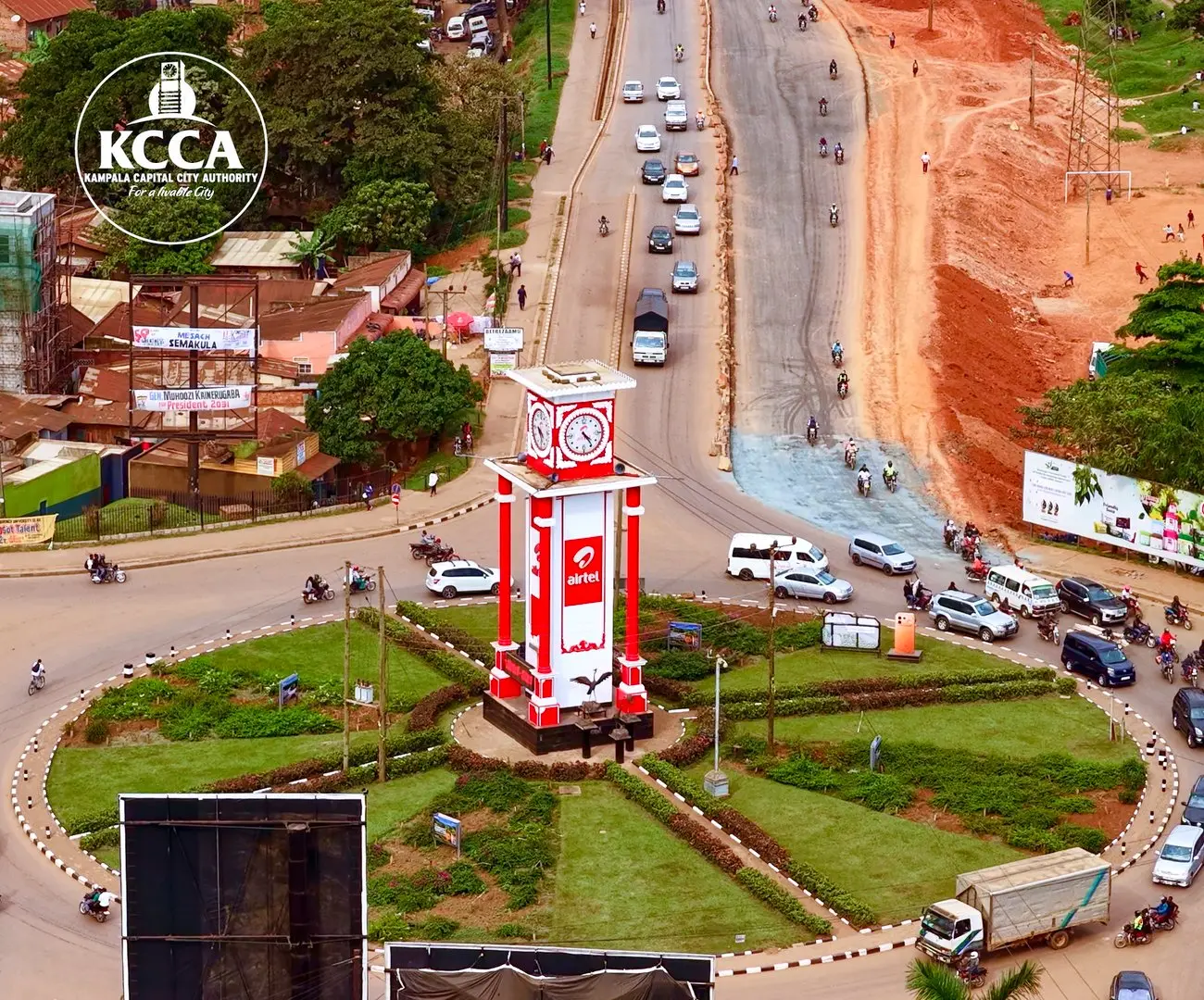
An iconic piece of Kampala’s history is scheduled for demolition. The Kampala Capital City Authority (KCCA) will tear down the historic Kibuye Roundabout, replacing its famous flower gardens with a synchronized traffic light system.
The radical move aims to dismantle a notorious bottleneck trapping commuters daily, clearing the path for an upgraded 1.26-kilometer, six-lane highway on Queens Way.
This infrastructure overhaul marks a dramatic shift in Kampala’s design. It pits modern, math-driven traffic engineering against decades of urban layout, all funded by a massive USD 288 million injection from the African Development Bank (AfDB) and the African Development Fund.
Urban planners have quietly audited Kampala’s worst choke points, concluding that the Kibuye Roundabout has become obsolete.
Kibuye acts as a high-stakes traffic funnel. It forces international cargo and daily commuter streams from the Kampala–Entebbe Road, Kampala–Masaka Road, Katwe, and Makindye into a single, chaotic circle.
While roundabouts safely manage moderate traffic, engineering reviews reveal they fail catastrophically under Kampala’s peak-hour volume. Vehicles entering the circle lock up those attempting to exit, creating a self-inflicted gridlock.
KCCA’s new strategy replaces human negotiation with synchronized signals. By calculating real-time traffic volumes, the automated lights will allocate exact “green windows” to high-volume lanes, dissolving the bottleneck.
The demolition closes a chapter on an area with roots stretching back to the 19th-century Buganda capital (the Kibuga). Modern transit needs have rapidly outpaced colonial-era planning:
Unlike previous city projects plagued by delays, an August 2026 audit by AfDB Country Manager Themba Bhebhe confirmed this project maintains a clean track record, free of embezzlement, corruption, and procurement irregularities.
The physical transformation of Queens Way is moving rapidly, bypassing early disruptions caused by the COVID-19 pandemic.
The broader KCRRP initiative stands at an 85% completion rate as of October 2026, up from 78% earlier in the year.
On Queens Way, contractors have finalized 75% of the drainage infrastructure and successfully laid down the first layer of asphalt on the right-hand side.
To protect foot traffic, KCCA is installing 3-meter-wide walkways between Kibuye and the Kayemba underpass, tapering to 2 meters toward the Clock Tower.
The entire 1.26km corridor will be illuminated by solar-powered streetlights to drive down nighttime accident rates.
KCCA Executive Director Hajjat Sharifah Buzeki is pushing contractors to complete outstanding works on schedule while maintaining strict environmental safeguards. With the roundabout’s days numbered, KCCA is already lobbying the AfDB to fund future integrated transport systems to permanently link the city center to the upcoming Busega Expressway network.
The introduction of scheduled, eco-friendly mass transit under the Kampala City Roads Rehabilitation Project (KCRRP) aims to break the city’s heavy reliance on informal, low-capacity 14-seater commuter taxis (matatus).
The rollout is divided into two distinct frameworks: KCCA’s long-term AfDB-funded Green Corridor Pilot and the rapidly expanding E-Bus Express network developed by Kira Motors Corporation (KMC)
Financed via a dedicated USD 12 million allocation from the African Development Bank, KCCA is establishing a 15-kilometer pilot “Green Bus Route”. This serves as the foundation for a future Bus Rapid Transit (BRT) network
To bypass chronic traffic jams, this corridor will feature a dedicated bus lane starting at the heart of the Central Business District (CBD
This circular loop covers Kampala’s densest commercial and institutional hubs, offering a direct alternative to passengers who traditionally rely on the Old Taxi Park networks.
While these buses feature modern automated ticketing and a low entry fare (starting at UGX 800 compared to fluctuating taxi fares), city planners admit scaling remains difficult:
Outside of the specialized KCCA pilot corridor, the broader Greater Kampala network lacks designated bus lanes. Electric mass transit must share the same narrow, potholed infrastructure as private cars, boda-bodas, and matatus.
To help the eco-buses maintain reliable timetables, KCCA’s Directorate of Transport and Road Management is racing to implement new traffic management systems. These include gazetting strict public vehicle stages, creating one-way restrictions, and altering intersection turn rights to favor larger mass-transit vehicles.


