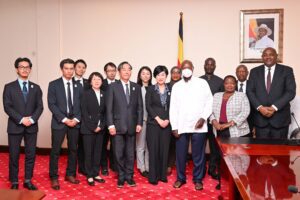
President Yoweri Kaguta Museveni has urged Japanese investors to scale up operations in Uganda, highlighting lucrative opportunities in the agro-processing sector. Additionally, the President called on the Japanese government to partner with Uganda by providing advanced road construction equipment to fast-track the country’s infrastructure development.
President Yoweri Museveni has called for enhanced bilateral ties with Japan and a boost to Uganda’s infrastructure resources following a diplomatic meeting at State House, Entebbe.
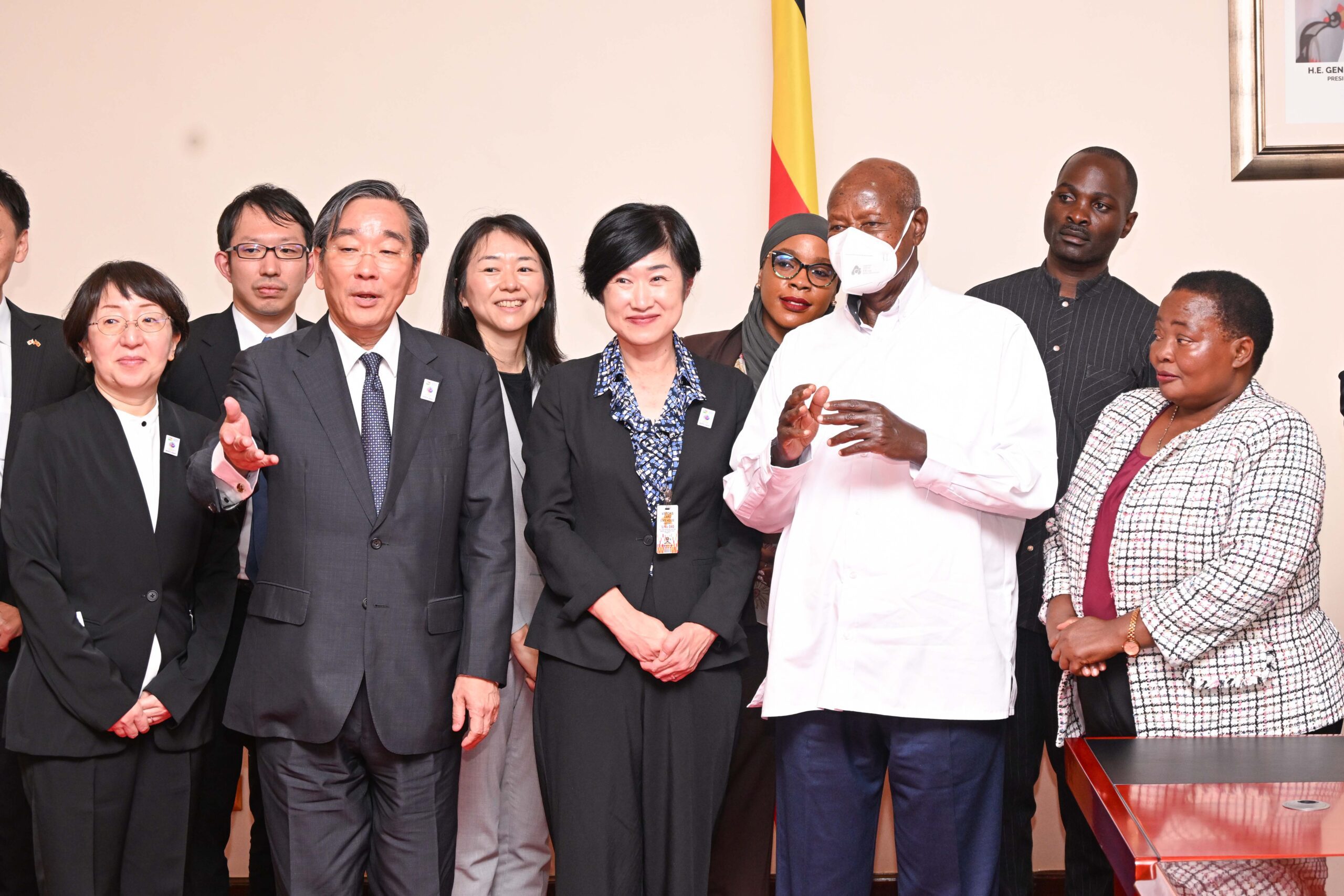
Hosting a Japanese delegation led by Ambassador Takahashi Misako (Director General and Assistant Minister for African Affairs), the President explored deeper cooperation across energy, investment, health, and education. Museveni expressed appreciation for Japan’s instrumental role in major infrastructure achievements, including the Kampala Flyover and Karuma Bridge.
To improve road networks countrywide, Museveni noted that Uganda requires a significant influx of road construction equipment. Rather than sharing regional machinery, the President proposed that every local government should secure its own dedicated fleet to streamline operations.
President Museveni is pushing for a major upgrade in Uganda’s infrastructure strategy, calling for every region to own independent heavy road machinery.
Rather than relying on shared equipment, Museveni wants districts fully armed with their own graders, trucks, and compactors. The focus is on functionality over flashiness: the machinery can be used, as long as it is durable and easily repairable by local mechanics.
Highlighting Uganda’s long-standing trust in Japanese engineering—specifically brands like Komatsu—the President wants to buy more. He is organizing a group meeting with Japanese firms in Uganda to personally dismantle the bureaucratic and operational bottlenecks holding them back.
Museveni is also urging Japan to pivot harder into Ugandan agro-processing. By shifting away from raw exports and investing in value-addition, Uganda aims to drive job creation and stimulate economic growth.
The Japanese delegation said Japan would continue supporting Uganda’s development through infrastructure projects, human resource development,education, health and refugee support.
Ambassador Misako said Japan was considering additional support for the Kampala Flyover and road upgrading projects and was also exploring possible support for the improvement of the Kibuye-Busega road.
On the reconstruction of Karuma Bridge, the Ambassador said a groundbreaking ceremony was planned for November and expressed hope that President Museveni would attend, subject to his schedule.
“We would also very much like President Museveni to attend this ceremony if the schedule allows,” she said.
The Ambassador said Japan remained committed to supporting Uganda’s efforts to improve the welfare of refugees and host communities.
“Uganda accepts the largest number of refugees in Africa,” she said,adding that Japan would continue supporting Uganda in addressing the needs of refugees and host communities.
She also commended Uganda’s contribution to regional peace and stability, particularly its deployment of troops to Somalia and the Democratic Republic of Congo.
The Ambassador recalled Japan’s support to Uganda during the Ebola outbreak and commended the Government and people of Uganda for their response to the epidemic.
Speaking on bilateral ties, the Japanese Ambassador highlighted that 17 Japanese companies are already thriving across Uganda’s vital sectors, including transport, healthcare, manufacturing, and agriculture. She commended President Yoweri Museveni for fostering a stable market, while emphasizing that keeping the momentum going relies on one core ingredient: transparency.
“Ensuring a free and fair business environment is extremely important for promoting foreign investment and further advancing Uganda’s economic development,” the Ambassador noted.
The partnership extends far beyond corporate investments into heavy human capital development. To date, Japan’s impact on Ugandan youth and education includes: Over 200 Ugandans have pursued advanced studies under prestigious Japanese Government scholarship programs.
More than 4,000 Ugandans have upskilled in Japan through the Japan International Cooperation Agency (JICA). 846 JICA Overseas Cooperation Volunteers have been deployed nationwide, with 37 actively on the ground today.
With a partnership rooted in history, the Ambassador also lauded Uganda’s active role in the Tokyo International Conference on African Development (TICAD), a cornerstone of Japan-Africa relations since 1993.