





Mbale, Uganda — Mbale City has signed a strategic cooperation agreement with Guiyang City in southwest China, laying the groundwork for a direct-sourcing partnership aimed at expanding Uganda’s Arabica coffee footprint in the Chinese market
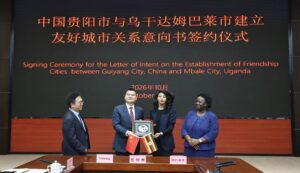
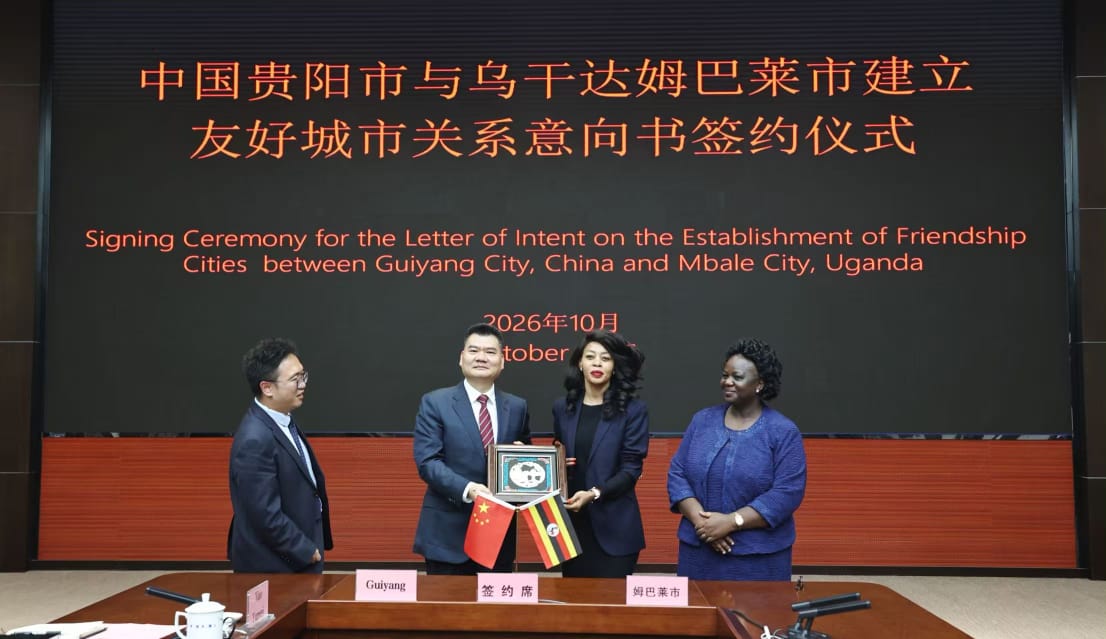
The Letter of Intent was signed on Tuesday in Guiyang, Guizhou Province, by Mbale City Mayor Joyce Matuka Kidulu and Guiyang Mayor Wang Hong.
The deal is an intentional step toward establishing an official sister-city partnership between the two municipalities
Beyond coffee and agriculture, the framework outlines four other priority areas: Smart cities and digital governance,Industrial development and investment,Tourism and cultural exchange and Environmental sustainability
To turn the framework into action, both municipal governments agreed to set up a joint working group within two months and organize a technical delegation visit to Mbale. That visit will evaluate local opportunities spanning the coffee value chain, the city’s gazetted industrial park, and tourism sites.
The signing ceremony took place during a broader working visit to Guiyang by a Ugandan delegation featuring officials from the Ministry of Agriculture, Animal Industry and Fisheries (MAAIF) and staff from the Uganda Consulate General in Guangzhou
During the mission, the delegation held a dedicated coffee trade promotion and business matching session alongside the Guiyang Coffee Industry Association
Industry leaders in Guiyang made it clear they want to shift away from buying Ugandan coffee through third-party intermediaries in other countries—where beans often end up anonymously mixed into regional blends.
Lu Yuan, President of the Guiyang Coffee Industry Association, noted that local companies have already imported more than 150 tonnes of Ugandan coffee and plan to scale up volumes.
The association aims to establish direct-sourcing pipelines, joint marketing campaigns, and long-term contracts linking Mbale exporters directly with roasters and retailers across Guizhou province.
According to the Uganda Consulate General in Guangzhou, Uganda’s overall coffee exports to China surged by 224% in the 2025/26 financial year
Ambassador Judyth Nsababera, Uganda’s Consul General in Guangzhou who coordinated the engagement, welcomed the Chinese buyers’ push for direct traceability. She noted that Uganda’s dual-harvest climate allows it to supply distinct, traceable Robusta and Arabica profiles, positioning the country to capture fast-growing specialty markets. She invited Guiyang roasters to send samples and organize reciprocal trade visits to Mount Elgon’s growing regions
Mayor Joyce Matuka Kidulu framed Mbale as the commercial heartbeat of eastern Uganda and the epicentre of the nation’s Arabica production on the fertile slopes of Mount Elgon. She highlighted Mbale’s strategic positioning along the Northern Corridor, regional access to the 300+ million-strong East African Community (EAC) market, local industrial parks, and cultural-eco-tourism assets like the Bamasaaba Imbalu ceremony, Mount Elgon National Park, Sipi Falls, and Wanale Ridge
Mayor Wang Hong described Guiyang—recognized as a national big data pilot zone and ecological demonstration hub—as a rapidly expanding market eager to deepen agro-processing, digital economy, and tourism ties with Mbale. Yang Liu, deputy director of the Guiyang Foreign Affairs Office, and representatives from the Guiyang Foreign Trade Development Group also attended the talks
Mbale Arabica coffee—commonly traded as Bugisu Arabica—is grown on the fertile volcanic slopes of Mount Elgon in Eastern Uganda. It is widely considered one of the finest specialty coffees in Africa due to its unique high-altitude microclimate and traditional processing methods.
Traditionally exported to Europe and North America for use in premium espresso blends, Mbale Arabica is now aggressively pivoting toward direct-trade, single-origin packaging for fast-growing Asian markets like China


