








Uganda is aggressively positioning its manufacturing sector as the primary engine for an ambitious economic leap, targeting a $500 billion economy under its bold Ten-Fold Growth Strategy. According to government projections, the industrial sector is expected to expand at an annual rate of 6.4%, lifting its contribution to the nation’s Gross Domestic Product (GDP) to 24.9%.
Minister of Trade, Industry and Cooperatives, Hon. Sanjay Tanna, says Uganda’s manufacturing footprint has expanded exponentially from a modest base of just 81 factories in 1986 to more than 12,000 formal manufacturing enterprises today. This structural pivot is fundamentally re-shaping the macro-fiscal landscape of East Africa’s third-largest economy.
He noted that the industrial sector has evolved into a critical anchor for domestic revenue and employment. It currently employs over 1.8 million Ugandans and generates 33% of the total tax revenue collected by the Uganda Revenue Authority (URA).


“This domestic capacity has altered Uganda’s trade balance. Total exports of goods and services surged by an astounding 204%, skyrocketing from US$5.93 billion in 2022 to US$18.04 billion in 2026. While traditional commodities like gold, coffee, cocoa, and fish remain vital, manufactured goods now comprise 24.6% of total merchandise exports. Notably, Uganda has achieved net-exporter status for several consumer and industrial staples it historically imported, including sugar, milk, soap, cooking oil, salt, cement, steel, and paper,”Tanna stressed.
To sustain this manufacturing momentum, the state has addressed infrastructure and utility bottlenecks through its core industrial zone roadmap:
-
- Industrial Parks: Out of 22 planned state-backed industrial zones, eight are fully operational. These hubs have attracted US$5.8 billion in combined domestic and foreign direct investment (FDI) while creating more than 163,010 direct jobs.
- Power Concessions: Industrial activity now consumes over 70% of Uganda’s total electricity generation. To preserve cost-competitiveness, the government has aggressively lowered high-energy tariffs down to 5.7 US cents per kilowatt-hour for manufacturers.
An analytical look at Uganda’s strategy reveals that its industrial execution rests heavily on state-backed development finance institutions (DFIs) rather than relying solely on commercial banking, which is often constrained by high interest rates and short-term tenors. The government is systematically scaling up two primary institutions to provide long-term patient capital:
-
- Uganda Development Bank (UDB): Currently operating with a cumulative capital pool of approximately UGX 1.6 trillion to underwrite heavy manufacturing finance.
- Uganda Development Corporation (UDC): The government’s investment arm has been handed an aggressive UGX 5 trillion capitalisation target over the next five years.
Over the past decade since its re-establishment in 2016, UDC has injected capital into 28 strategic companies. According to UDC Executive Director Dr. Patrick B. Birungi, these state-supported enterprises have created 5,799 direct jobs, generate US$14.22 million in export earnings, and pay roughly UGX 138.45 billion annually to local farmers and suppliers by consuming over 35,000 tonnes of domestic agricultural produce.

While domestic consolidation is well underway, the true test of Uganda’s Ten-Fold Growth Strategy lies in its ability to penetrate external markets. Manufacturers are being positioned to leverage tariff-free and preferential access across three core trade blocs: the East African Community (EAC), the Common Market for Eastern and Southern Africa (COMESA), and the newly operational African Continental Free Trade Area (AfCFTA). The latter unlocks a massive continental market of roughly 1.4 billion people.
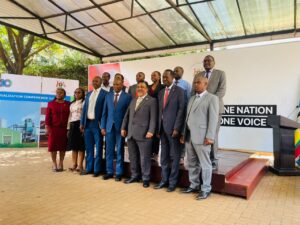
To bridge the gap between policy design and commercial execution, the Ministry of Trade, alongside UDC and the United Nations Industrial Development Organization (UNIDO), is convening the National Industrialisation Conference 2026 from November 18 to 20 at the Speke Resort Munyonyo in Kampala. Held under the theme “Celebrating Uganda’s Industrial Growth,” the event coincides with Africa Industrialisation Day on November 20 and marks 10 years since UDC’s revival.
“We intend to move the industrialisation conversation beyond policy discussions into tangible investments, business partnerships, financing, and market access,” Dr. Birungi emphasized.


Demonstrating that the agenda is moving fast into active execution, the government is showcasing its active investment portfolio through high-profile project launches this month:
-
- November 5: Groundbreaking of Pamoja Packaging and Industrial Solutions Limited in Mukono.
- November 6: Commissioning of Bukona Fuel Blending Limited in Malaba to bolster local energy security.
- November 10: Launch of a new specialized production line at East African Medical Vitals Limited in Namanve, targeted at regional pharmaceutical demand.
As policy makers, global financiers, and industry titans prepare to gather at Munyonyo, the focus is expected to shift toward unresolved structural bottlenecks. To unlock the next phase of exponential growth, delegates will need to confront pressing systemic issues: fast-tracking bureaucratic product certifications, curbing the influx of counterfeit goods, and deepening raw material value addition within high-value niches like iron, steel, agro-processing, and medical pharmaceuticals.


