







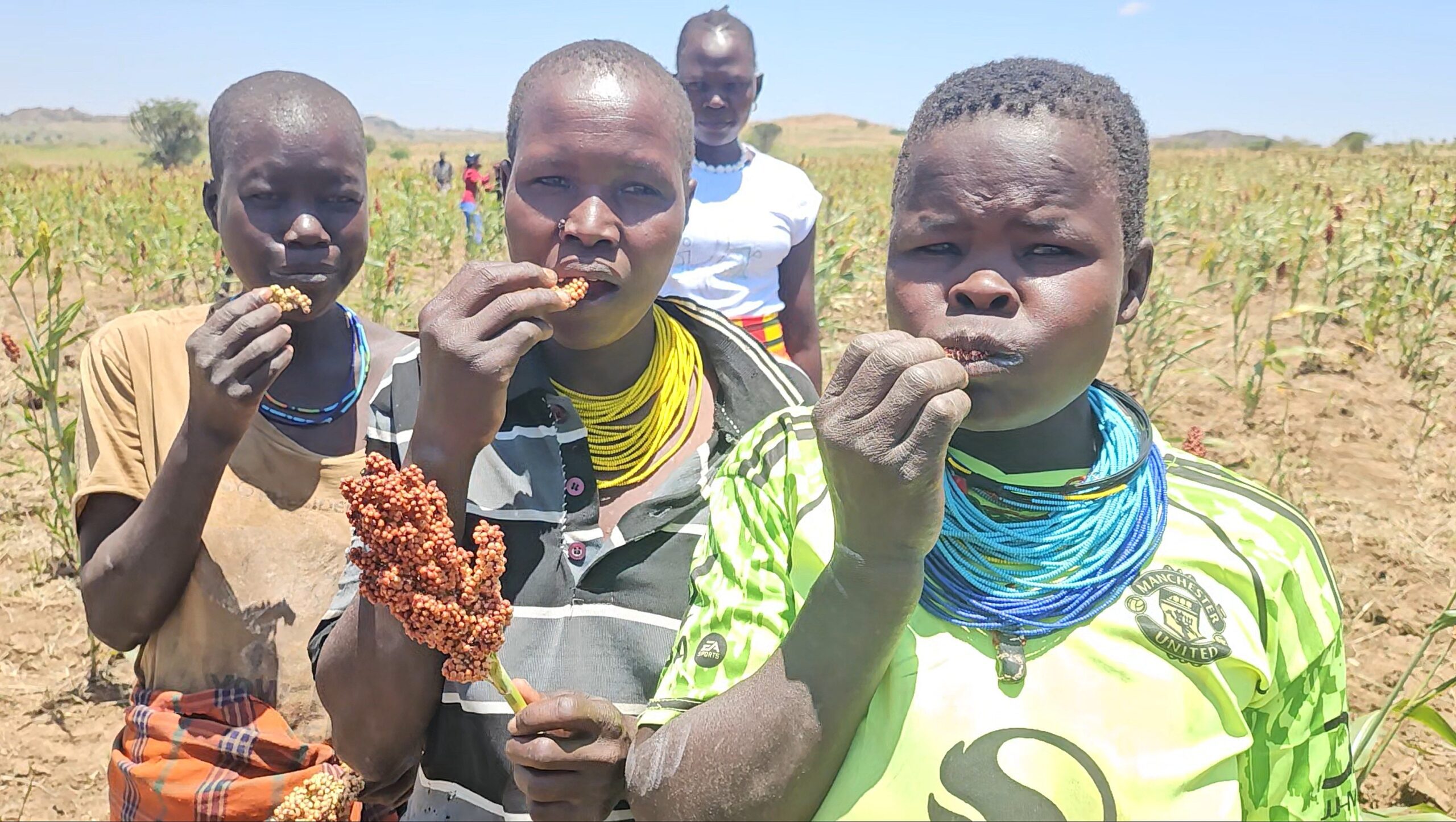
Under the blistering sun of Karamoja, the earth usually cracks, and crops wither into dust. This year, as a severe drought pushes thousands of families deeper into food insecurity, the fields of Kaabong District should be barren. Yet, in Katile Sub County, a five-acre green oasis stands tall against the heat, laden with heavy, golden grain.
This is NAROSORG2 (NARO Sorghum 2), a climate-resilient crop developed by the National Agricultural Research Organisation (NARO). As traditional crops fail across the subregion, this engineered variety is doing the unthinkable: it is thriving, offering a lifeline to a region long battered by climate shocks.


“It is early maturing, it is drought tolerant, it can withstand extreme drought and still give you some good degree of yield,” explains Dr. Walter Odongo, Director of Research at NAROs Nabuin Zonal Africultural Research and Development Institute
Speaking at a recent farmer’s field day in Katile, Dr. Odongo revealed the variety’s secret weapon—one that has local farmers ecstatic. “The third strong attribute… is that this variety of sorghum is not eaten by birds, which are a very common production constraint within the region.”
By being unpalatable to birds and highly resistant to intense heat, the crop eliminates the two biggest risks to a successful harvest.

For generations, agricultural aid in Karamoja has focused on emergency relief. NARO is trying to change the narrative from mere survival to sustainable production.
Through the Uganda Climate-Smart Agriculture Transformation Project (UCSATP), NARO has established massive parish-level demonstration gardens, spanning five to ten acres, across all six districts of Karamoja.
Dr. Ijara Anthony Raphael, a Senior Research Officer at NARO, notes that the changing climate triggered an urgent need for innovative tech. NAROSORG2 takes just 80 days to mature from planting to harvest. In an area where the rainy season is shrinking rapidly, speed equals survival.
“Under the project, we are promoting early maturing varieties to try to reduce food insecurity in this region and also improve their household income,” says Dr. Damalie Akwango,UCSATP Coordinator . The long-term strategy is supporting local seed multiplication so communities can independentally access and grow these seeds without relying on outside aid. “This is Phenomenal”


The success of the demonstration gardens has brought profound relief to local leaders. Kaabong District LCV Chairman, Lotyang Albert Loris, speaks candidly about the agony of watching his people starve.
“There is no doubt that our people are suffering. They have no food. And it is not because of laziness, but the weather conditions can be so harsh,” Loris says.
For Loris, the 80-day maturity timeline is a game-changer. “Looking at the fast maturity of this crop, people would even be able to introduce a second harvest season in a year. This is phenomenal.”
The true test of any agricultural technology lies in the hands of the people who dig the soil. NARO’s strategy involved local extension workers and farmers working side-by-side through every single stage of production—from breaking the hard ground to managing the fields.


“We have worked on this demonstration farm together with the farmers right from the time of land opening up to the level where we are able to see this good yield,” says Miriam Akitwi, a local extension worker. She notes that the community is already re-evaluating what is possible, praising NAROSORG2 as a “rare variety.”
For local farmer Apui John Baptist, the contrast between the past and the present is stark.
“This is a good variety which can manage the conditions in Karamoja better than the one we have been growing,” Apui says, looking out over the resilient fields. “My message to the Government and NARO is that we are happy. As a farmer, I’m happy.”
As the harvest in Katile nears, the ambition is to move the seeds and the knowledge out of the demonstration plots and into the backyard of every household in Karamoja, turning a single green field into a region-wide agricultural revolution.


