





Vice President Jessica Alupo called for faster local manufacturing, value addition, and industrial investment to help grow Uganda’s economy tenfold to US$500 billion by 2040. Speaking on behalf of President Yoweri Kaguta Museveni as Guest of Honour at the Africa Industrialisation Day 2026 commemoration at Munyonyo Commonwealth Resort in Kampala, she urged Uganda to move beyond raw material exports and strengthen domestic production.
Alupo noted that Uganda’s economy has grown from US$3.9 billion in 1986 to about US$69 billion, with projections reaching US$80 billion in the following year. However, she stressed that economic size alone is not enough without structural change. “A bigger economy is not enough if the structure stays colonial,” she said, calling for local raw material processing and mineral beneficiation.
Using coffee as an example, Alupo pointed out that Uganda loses potential earnings by exporting raw beans at roughly US$2 per kilogramme instead of processing them locally into finished goods that can sell for up to US$40 per kilogramme.
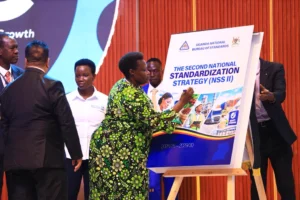
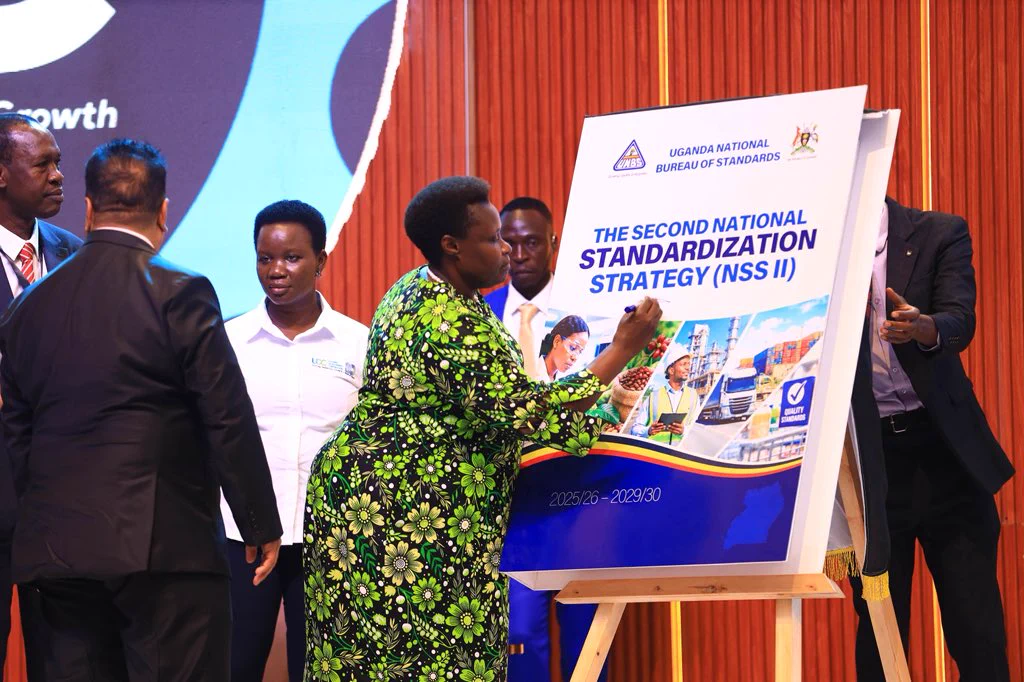
During the event, the Vice President launched three initiatives to strengthen Uganda’s industrialisation framework:
- E-Services Portals: Developed by the Ministry of Trade, Industry and Cooperatives (MTIC) with the National Information Technology Authority–Uganda (NITA-U).
- Second National Standardisation Strategy (NSS II): Incorporates Agro-Industrialisation, Tourism, Mineral-Based Industrial Development, and Science, Technology and Innovation (ATMS) standards.
- Uganda Development Corporation (UDC) Strategic Plan: Covers FY 2025/26 to FY 2029/30.
Alupo outlined measures to lower costs and back local producers, including: Patient Capital: UGX 1.6 trillion channeled through the Uganda Development Bank (UDB),target industrial electricity rate of US$0.05 per kilowatt-hour in industrial parks and Stronger enforcement of the Buy Uganda, Build Uganda (BUBU) policy and crackdowns on smuggling and counterfeits.
MTIC Permanent Secretary highlighted UDC’s UGX 21.4 billion investment in East African Medical Vitals, which supports production of about 80 million medical gloves, with plans to invest another UGX 31 billion in the next financial year to target 300 million gloves.
Trade Minister Sanjay Tanna: Noted UDC’s 10-year record in backing domestic industries and stated that manufacturing accounts for 24.7% of Uganda’s GDP and about 24% of total goods exports. “Our industrialisation ambition must go beyond producing raw materials for export. We must build industries that add value to our agricultural produce, minerals and other resources, create jobs and strengthen our competitiveness. Through the ATMS priorities and strategic institutions such as UDC, government is committed to accelerating investment and positioning manufacturing at the centre of Uganda’s tenfold economic growth ambition by 2040,” Tanna said.
UNIDO Representative Bruno Otto: Urged greater use of affordable long-term financing, blended finance, and public-private partnerships across agro-processing, pharmaceuticals, automotive manufacturing, and mineral beneficiation. “Financing commitments must translate into tangible results, including increased productive capacity, greater value addition, more competitive industries and the creation of decent jobs,” Otto said.
Conference organizers also highlighted that Uganda has more than 12,000 formal manufacturing industries employing over 1.8 million people. Held under the theme “Celebrating Uganda’s Industrial Growth,” the three-day National Industrialisation Conference brought together government officials, manufacturers, investors, and development partners to advance the country’s industrial agenda.


