

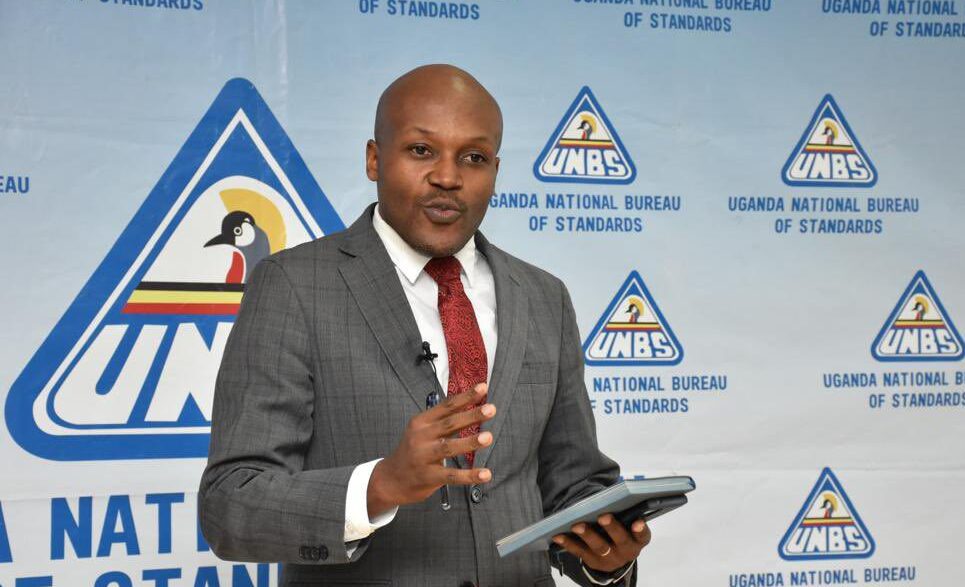
In its effort to safeguard the health and safety of consumers, Uganda National Bureau of Standards (UNBS) has intensified market surveillance inspections across the country, targeting locally manufactured as well as imported products that do not meet quality, safety and performance standards as well as expired products, that are distributed and sold by some wholesalers and retailers. The inspections are to ensure that products availed on the market comply with applicable compulsory Uganda standards and are safe for consumption.
During the last financial year 2025/2026, UNBS seized more than 880 tons of substandard products worth about 3 Billion Uganda shillings. These included food products, cosmetics and construction materials, among others. The seizure of these dangerous substandard products saved the health and safety of thousands of consumers who would have been badly affected or injured if they consumed or used these products.

UNBS carries out inspections and checks and seizes substandard products found in shops, supermarkets, warehouses and uncertified manufacturers in order to deny them shelf space and thus availability to unsuspecting consumers. This also protects compliant manufacturers and traders from unfair competition.
The inspections are in line with the UNBS mandate of enforcing standards in protection of public health and safety, as well as the environment, against dangerous and sub-standard products, as prescribed in the UNBS Act Cap 210 and the UNBS (Market Surveillance and Enforcement of Compulsory Standard Specifications) Regulation 2021. The Act also prohibits importation, manufacture, sale, distribution or holding for the purpose of selling any product that does not meet compulsory Uganda standards.
During the last financial year, 6,642 inspections were conducted by UNBS all over the country at Points-ofsale, food processing facilities, distribution trucks, chemical and consumer factories, steel and engineering factories among others. In terms of regional coverage, the Central region had the highest number of inspections, followed by the Western region, then Eastern region and the Northern region.
In the process of inspecting, a number of businesses that were found in contravention of compulsory standards, including general goods outlets and shops (both wholesale and retail), stores and supermarkets, hardware shops, cosmetics shops and factories, maize mills, bakeries, alcoholic and non-alcoholic beverage manufacturing facilities, paint factories, steel factories and other construction materials factories, were sensitized and guided on how to comply with the relevant standards. Some of these were made to temporarily halt production operations and made to correct their mistakes and upon confirming the corrections they were allowed to resume operations.
On an encouraging note, out of 2,622 manufacturing facilities inspected, 1,996 facilities were found to be compliant, giving a 76% compliance rate among manufacturers. This can even be improved and demonstrates a growing awareness among manufacturers about the importance of adhering to national standards.

UNBS therefore urges all manufacturers that are not yet certified to seek certification of their products before placing them on the market. In its efforts to grow quality enterprises, UNBS is committed to supporting and guiding manufacturers and all value-addition enterprises that are not yet certified to apply for and obtain certification of their products. UNBS also urges all traders to ensure that they only deal in safe products that will not affect the health and safety of their customers.
UNBS remains committed to protecting consumers and the environment from substandard products and encourages all consumers to purchase only products certified by UNBS and bearing the UNBS Q-Mark.
The public is encouraged to report to UNBS any substandard products that they come across using toll-free line 0800133133 / 0800233233.
The Uganda National Bureau of Standards is a government agency mandated to develop, promote and enforce standards to protect public health, safety, and the environment as well as ensuring fairness in trade and precision in industry through reliable measurement systems.
