

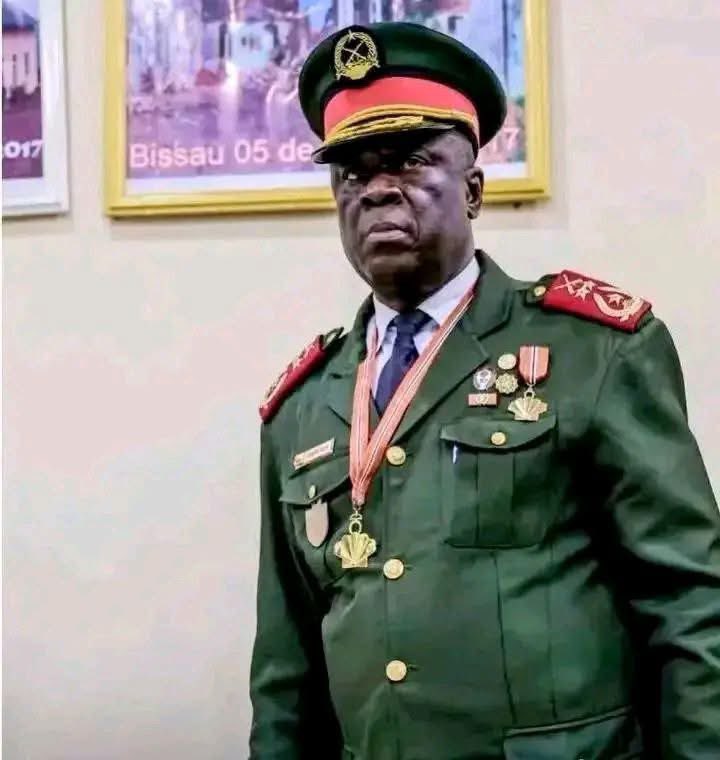
Gen Horta N’Tam has been sworn in as Guinea-Bissau’s new head of state a day after an apparent coup.
He becomes the transitional president for a period of one year. He took the oath in brief and muted proceedings at army headquarters.
N’Tam, who until a day earlier had been head of the presidential guard, barely cracked a smile during his swearing-in or while stood outside flanked by officers while for cameras.

Some civil society groups in Guinea-Bissau have accused outgoing President Umaro Sissoco Embaló of masterminding a “simulated coup” against himself with the help of the military, saying it was a ruse to block election results from coming out in case he lost.
“This manoeuvre aims to prevent the publication of the electoral results scheduled for tomorrow, November 27,” the civil society coalition Popular Front said in a media statement.
Embaló survived multiple coup attempts during his time in office. However, his critics have previously accused him of fabricating crises in order to crack down on dissent.
The military has already suspended the electoral process and blocked the release of the results of Sunday’s presidential election which were expected on thursday.

In response to news of the apparent coup, the chair of the African Union (AU) Mahmoud Ali Youssouf demanded “the immediate and unconditional release of President Embalo and all detained officials”.
He also reminded Guinea-Bissau’s leaders of “the imperative of respecting the ongoing electoral process”.
Sandwiched between Senegal and Guinea, the West African country is known as a drug-trafficking hub where the military has been influential since independence from Portugal in 1974.
Guinea-n a joint statement, leaders of election observation missions from the African Union and the West African bloc Ecowas expressed deep concern with the announcement of a coup d’etat by the armed forces.
They said the country had been prepared for the announcement of the election results after what it described as an orderly and peaceful process.

“It’s regrettable that this announcement came at a time when the missions had just concluded meeting with the two leading presidential candidates, who assured us of their willingness to accept the will of the people,” they said.
Bissau has witnessed at least nine coups or attempted coups over the last five decades.
Guinea-Bissau’s economy is small, developing, and heavily reliant on subsistence agriculture and foreign assistance, making it one of the world’s poorest nations. The economy depends significantly on cashew nuts and fishing for exports, though illegal logging and drug trafficking also play a role. Challenges include political instability, weak infrastructure, low productivity, high public debt, and over-reliance on a few export crops.
Around 80% of the workforce is employed in agriculture, with cashew nuts being the main export, making up over 80% of income. Other agricultural products include rice, peanuts, cotton, and timber, but production is hampered by poor infrastructure.The country relies heavily on foreign assistance and faces high public debt, requiring substantial concessional support to fund development projects.

Political instability has historically hindered economic growth and development efforts. Weak law enforcement has also led to the country being a transit point for drug trafficking.
Guinea-Bissau possesses untapped reserves of oil, gas, and minerals like bauxite and phosphates that could boost future economic growth if developed sustainably.
The majority of the population lives below the absolute poverty line, particularly in rural areas where poverty persists due to vulnerabilities in the agricultural sector.