







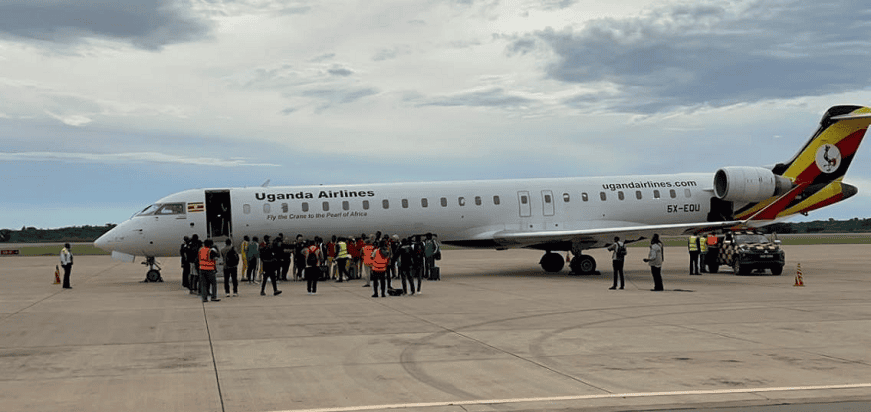
The rhythmic hum of aircraft engines over Kabaale Sub-county shattered a long-standing silence on Sunday, signaling a historic milestone for Uganda’s aviation and economic landscape. As an Eagle Air flight carrying Confederation of African Football (CAF) officials touched down smoothly on the newly minted 3.5-kilometer runway—swiftly followed by the Libyan national team and the Uganda Cranes—Kabalega International Airport triumphantly passed its first major operational litmus test.
While these maiden flights represent a monumental leap forward, they arrive alongside news of a revised timeline.


The official, full-scale commissioning of the facility, previously anticipated earlier, has now been set for January 2027, where President Yoweri Museveni is expected to formally inaugurate the strategic gateway.
Works and Transport Minister Fred Byamukama said the first phase of the airport project is now 99.9% complete, with most major facilities already in place. He said the contractor is expected to hand over the completed first phase to the Ministry of Works and Transport within the next two weeks.
Byamukama said work on the second phase, which will include construction of a passenger terminal with a capacity of 1,000 people, is expected to begin soon. The government has earmarked 232 billion shillings ($62 million) for the second phase, he said.

For the residents of Hoima and the wider Albertine region, the roar of these arriving aircraft carries weight far beyond the immediate thrill of the upcoming 2027 Africa Cup of Nations (AFCON). It stands as a tangible monument to structural transformation.
“We have watched the dust rise and fall here since 2018. Seeing the Uganda Cranes land right here in our backyard makes years of anticipation feel entirely worth it. It is proof that Hoima is no longer a isolated hinterland; we are now directly connected to the world.” John Byaruhanga, Kabaale resident and local trader.
“Our youth are actively positioning themselves for emerging opportunities in transport, hospitality, and logistics. When this airport unlocks the full potential of our oil and tourism sectors, we intend to be active participants in the story, not just spectators looking through the fence line.” Grace Asiimwe, Hoima District youth community leader.

Works and Transport Minister Fred Byamukama confirmed that the initial phase of construction stands at an impressive 99.9% completion. The joint-venture contractor—comprising Israeli-British firms Shikun & Binui International (SBI) and Colas Limited—is slated to officially hand over the first phase within the coming weeks.
With the runway operational, attention immediately shifts to Phase Two. The government has earmarked 232 billion shillings ($62 million) to construct an expansive, state-of-the-art passenger terminal capable of handling 1,000 travelers at a time, vastly upgrading the current interim facility. Despite weathering previous headwinds, including a brief funding-related suspension in 2023, the mega-project is forging ahead as a critical pillar for Uganda’s impending commercial oil production and regional trade networks.
The arrival of passenger aircraft marks a profound economic turning point for the Bunyoro region, completely rewriting local property valuations and setting off a commercial gold rush. The shift from quiet agrarian life to high-stakes commercial real estate is moving at a blistering pace:


Skyrocketing Land Valuations: Acreage surrounding the airport—stretching across the strategic nodes of Nyamasoga, Kabaale, and Buseruka—has experienced unprecedented appreciation. Fields once dedicated exclusively to subsistence farming are rapidly morphing into premium logistics hubs and corporate commercial zones.
A Blueprint for Urban Resettlement: To pave the way for this massive footprint, the government successfully managed the permanent acquisition of land and the subsequent relocation of 4,000 households to the modern Kyakaboga Resettlement Village. This master-planned community boasts newly constructed schools, modern places of worship, and robust civic centers, setting a fresh national benchmark for structured urbanization.
The Housing Boom: A sudden influx of international engineers, supply-chain experts, and energy sector personnel has triggered a sharp housing deficit. In response, local property developers are aggressively breaking ground on high-density residential complexes and commercial rentals to meet the premium demand.

An Industrial Catalyst: Local businesses are rapidly scaling up from micro-trade to sophisticated service provision. Capitalizing on this momentum, the Uganda National Oil Company (UNOC) has already secured commitments from 31 anchor investors for the adjacent industrial cluster, which is set to anchor petrochemical facilities, advanced agro-processing plants, and high-capacity ICT data centers.
Henry Bazira, Executive Director of the Water Governance Institute and a CSCO member, praised the progress but stressed the importance of promoting local content to ensure that Ugandan investors and communities benefit from the country’s oil and gas sector.
Robert Mukondo, Social Development Specialist at UNOC, emphasised that the airport is central to the Kabalega Industrial Park [KIP], a key initiative to bolster Uganda’s oil and gas sector.
“Completing the airport is crucial, especially as we begin work on the oil refinery, which is scheduled to start this year with site clearing,” he said.


