






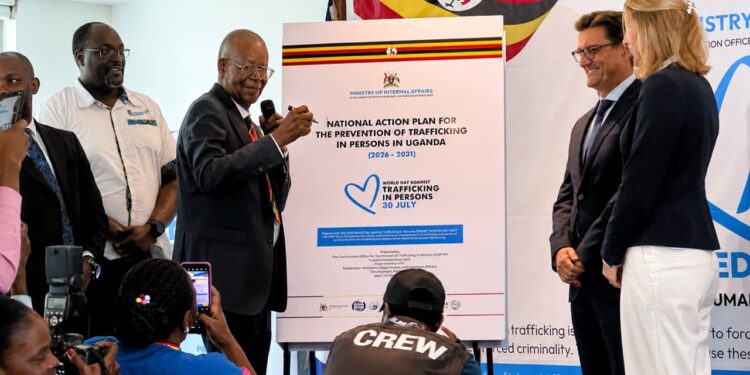
Uganda has intensified its fight against human trafficking by launching a new National Action Plan under the theme “Trapped Behind the Scam: The Hidden Human Cost Behind Cyber-Enabled Fraud.”
Minister of Internal Affairs Prof. Ephraim Kamuntu said children continue to bear the heaviest burden of crime. Of the 1,002 recorded victims, 555 were children, representing over 55 percent of all cases, while 447 were adults.
According to National Report on Countering Trafficking in Persons 2025 recorded a modest 6.18 percent decline in total reported cases from 1,068 in 2024 to 1,002 in 2025.


Prof. Kamuntu described human trafficking as a form of modern-day slavery and warned that the practice inflicts devastating harm on families and communities across the nation.
He emphasized that safeguarding young people begins at home, urging parents to instill strong moral values early to build a society that firmly rejects exploitation.
Derrick Kigenyi Basalirwa, Deputy National Coordinator at the Coordination Office for Prevention of Trafficking in Persons, explained that traffickers no longer rely solely on moving victims across borders. Instead, they exploit digital platforms to harvest personal data and recruit unsuspecting job seekers online, often coercing them into forced criminal labor or remote scams.
Echoing these concerns, Waiswa Abdu Salaam, Head of Legal at the Uganda Communications Commission, noted that while the internet offers vital opportunities for innovation and employment, predators routinely exploit young people desperate for work. He urged citizens to rigorously verify online job opportunities and avoid sharing personal information with unverified recruiters.


This localized crisis reflects a broader global issue, as human trafficking remains one of the fastest-growing forms of organized crime worldwide. Statistics indicate that approximately seven million people were living in modern slavery across Africa in 2021, accounting for 14 percent of the global total. Forced labor and sexual exploitation drive the majority of cases.
According to the United Nations Office on Drugs and Crime, nearly 79 percent of trafficking in Africa occurs within national borders, driven by poverty, high unemployment, armed conflict, and weak regulatory frameworks.
To counter these evolving threats, Uganda’s new National Action Plan outlines a multisectoral strategy that brings together security agencies, civil society groups, and international partners. Guided by the Prevention of Trafficking in Persons Act of 2009, the framework focuses on strengthening prevention, enhancing victim protection and survivor rehabilitation, promoting safe migration pathways, and aggressively prosecuting traffickers.
As criminal networks continue to adapt to the digital age, government officials maintain that public vigilance, parental guidance, and responsible technology use will remain crucial in protecting vulnerable Ugandans from modern slavery.