






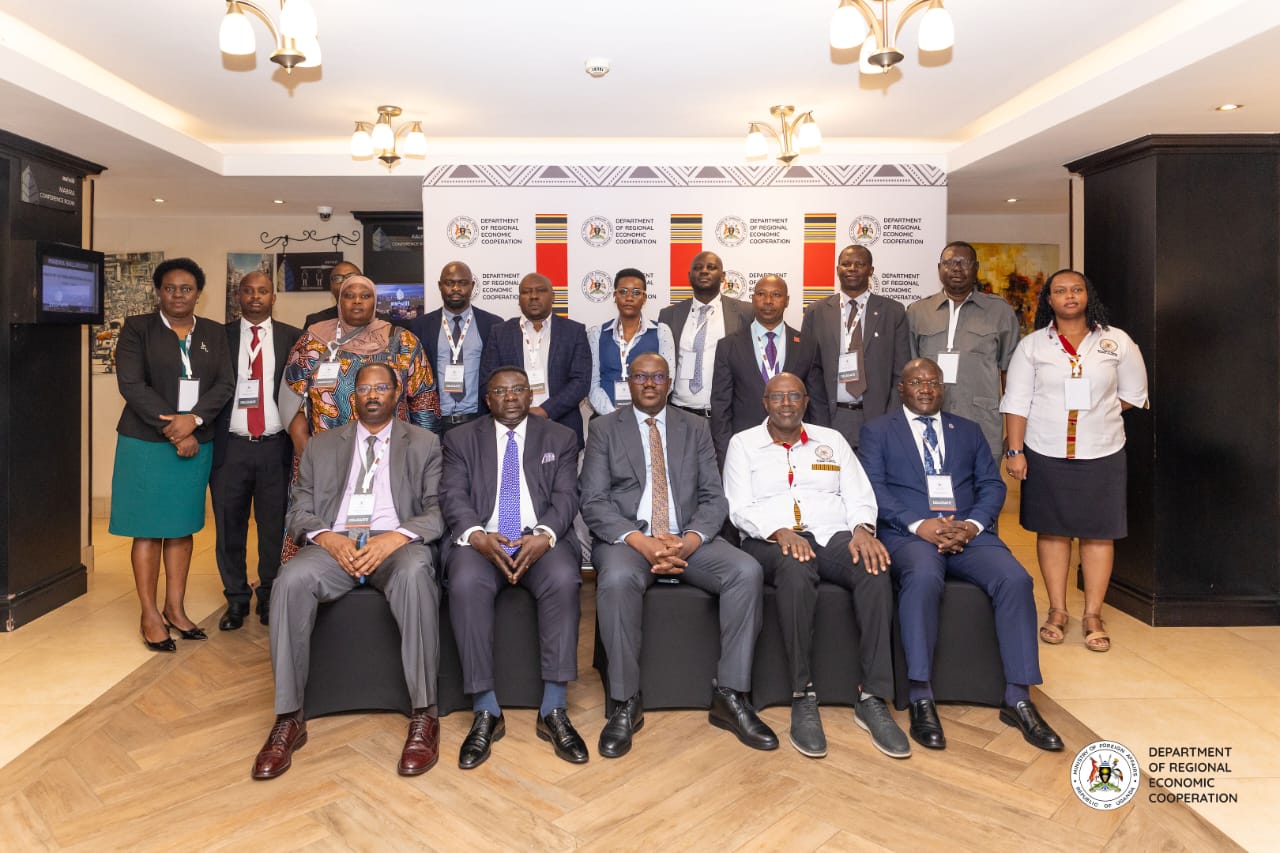
The Permanent Secretary Ministry of Foreign Affairs Vincent Bagire has instructed heads of Uganda’s missions abroad, several government ministries and agencies, and the Uganda Investment Authority to assess three years of work under the country’s Economic and Commercial Diplomacy strategy.
The retreat, held at the Mestil Hotel and running until 9 July under the title “Strengthening Institutional Collaboration for Effective Economic and Commercial Diplomacy Implementation,” is the government’s most detailed public accounting yet of what its embassies have delivered — and where the strategy is falling short.
He praised Uganda’s overseas missions for the consultative work behind them, but said the government could no longer measure success by the number of events held or meetings convened but missions needed to move from activity to outcomes, backing their work with solid statistics and proper documentation rather than anecdote.


Bagire announced that the Ministry has set up what it calls an ECD Operations Hub, intended to automate coordination between missions abroad, Ministry headquarters in Kampala, and the various government departments and agencies whose cooperation the strategy depends on.
He also pressed missions to sharpen their annual work plans and to publicise Uganda’s opportunities more aggressively, in coordination with the Ministry’s public diplomacy department, arguing that visibility abroad was as important as the deals themselves.
He linked the effort to Uganda’s wider ambition of a tenfold expansion of the economy and to the government’s long-standing Vision 2040 development plan.
Ambassador Richard Kabonero described the retreat as a chance to take stock before the new financial year beginning in 2026/27.


During the meeting Uganda’s mission in South Sudan presented economic data placing Uganda third by output among the eight members of the East African Community, behind Kenya’s roughly $147bn economy and Tanzania’s $95bn, and just behind the Democratic Republic of Congo.
The eight countries together produce about $435bn a year and are home to 355 million people.
Uganda’s mission in Switzerland offered the retreat’s most granular account of what commercial diplomacy looks like in practice.
Presented by Deputy Permanent Representative Arthur Kafeero, whose post in Geneva carries dual accreditation to the Swiss government and to more than 40 international organisations including the World Trade Organization, the mission has built its work around tourism, agro-industrial trade, sport-linked marketing and multilateral advocacy. Its tourism pitch rests on Switzerland’s unusual concentration of wealth: Geneva, a city of 211,000 people, counts 16 billionaires and roughly 90,000 millionaires; Zurich has 12 billionaires and about 99,300 millionaires.
Swiss residents spent an estimated 19.3bn francs, or roughly $24bn, travelling abroad last year, and the mission argues that a small share of that spending, at $50,000 to $250,000 a trip for high-end safari and lodge packages, would transform Uganda’s earnings from Swiss visitors.


Mission staff told the retreat they had already begun landing bookings this year, including multi-week trips to Uganda and Rwanda, with some travel agents now placing repeat business for 2027.
They are also exploring advertising tied to Swiss public transport, which carries six million commuters daily, and to Swiss ice hockey, a sport whose championship games draw around seven million television viewers among fans with high disposable incomes and a strong travel habit.
The mission is also coordinating with the finance ministry and the United Nations Conference on Trade and Development on Uganda’s graduation from Least Developed Country status, a process whose criteria Uganda met in March 2024, with a national validation workshop due in August this year and formal graduation expected around 2030 to 2032; officials argue the change in status would improve investor confidence and access to financing. Separately, the mission is working with the International Trade Centre in Geneva on a programme to improve Ugandan exporters’ access to European Union markets for products including avocado, cocoa, coffee, spices and tea, and on a scheme to expand financial inclusion and skills training for young women working in fashion, film and other creative industries.


Uganda’s mission in Abuja. Nigeria’s economy, recorded roughly $334billion nearly five times the size of Uganda’s, and its population of 236 million anchors a wider ECOWAS market of 442 million people.
Uganda’s recorded exports to Nigeria included tobacco, coffee, hides and skins, powdered milk, palm oil, fish, pharmaceuticals and precious minerals — totalled only about $34.6m, led by tobacco at $17.2m and pharmaceutical products, mainly antimalarials and antiretrovirals from Quality Chemicals, at roughly $11m.
Dr Omara Sam attributed the shortfall to a mix of practical and structural obstacles: long shipping distances, currency restrictions, limits on foreign ownership and capital movement, import quotas and licensing rules.
He also pointed to supply-side weaknesses back in Uganda as a constraint. Proposed remedies included making fuller use of Uganda’s African Continental Free Trade Area commitments, negotiating better terms bilaterally, using free trade zones and bonded warehousing, diversifying suppliers, and increasing trade missions in both directions — along with a note that Nigeria’s newly acquired first domestically owned cargo vessel could eventually help lower shipping costs between West and East Africa.


