

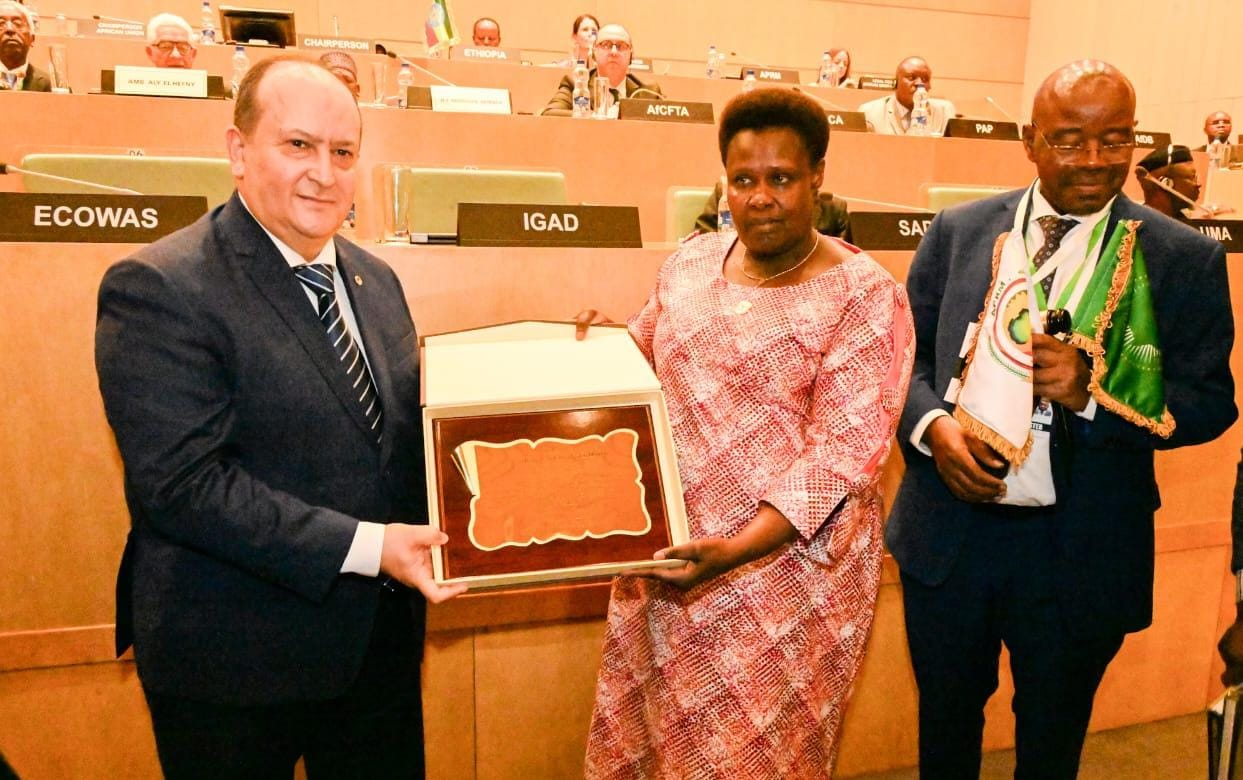
President Yoweri Museveni has assumed the chairmanship of the African Peer Review (APRM), positioning Uganda at the forefront of continental governance and developmental priorities.
Vice President Jessica Alupo received the instruments of power on behalf of President Museveni during the 35th Ordinary Session of the African Peer Review Forum of Heads of State and Government in Addis Ababa, Ethiopia today February 13, 2026.
He takes over leadership from Algerian President Abdelmadjid Tebboune and will serve as Chairperson of the APR Forum for two years. The APR Forum of Heads of State and Government is the highest decision-making body of the African Peer Review Mechanism.
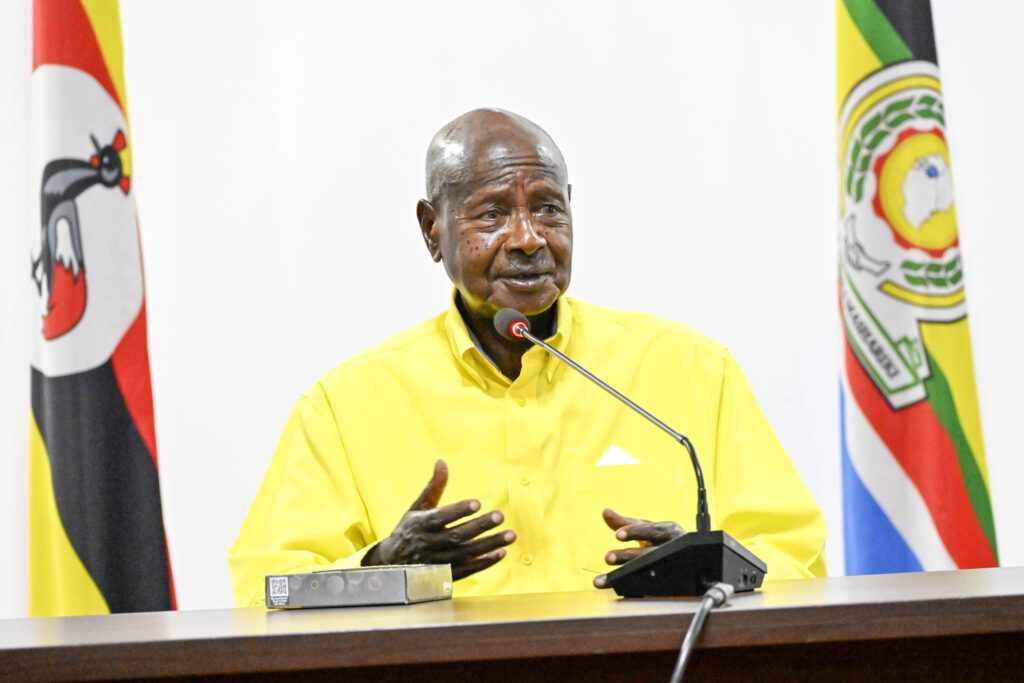
In his acceptance speech, delivered by the VP Alupo, President Museveni contributed $1m to support operations of the APRM. “I bring you greetings from the Government and People of the Republic of Uganda, on whose behalf I accept the responsibility of Chairperson of the African Peer Review Forum of Heads of State and Government,” Museveni said.
He thanked his brother and predecessor, His Excellency President Abdelmadjid Tebboune and the people of Algeria, for offering exemplary leadership and stewardship of the APR Forum. “Under your tenure, the mechanism has achieved significant milestones, including advancing the Africa Credit Rating Agency, completing multiple Country and Targeted Review Reports, publishing the Africa Governance Report on Natural Resource Governance and adopting the APRM Strategic Plan 2025–2028.
He noted that these achievements have strengthened the relevance, credibility and institutional foundations of the APRM. “They provide a firm platform upon which we shall build,” he said. The African Peer Review Mechanism was conceived as a voluntary, African-owned instrument for self-assessment, mutual accountability and peer learning. It is aimed at enabling our countries to identify some of the strategic bottlenecks to development and to take deliberate, evidence-based corrective action through honest peer engagement.

Museveni emphasised that APRM is now moving from diagnosis to action, from reporting to implementation and from process to measurable impact on the lives of our people. The said that nearly a decade ago, in his engagements with this Forum, he drew attention to a set of structural bottlenecks that continue to constrain Africa’s socio-economic transformation, ranging from weak infrastructure and fragmented markets to institutional fragility, governance deficits and limited value addition. “My argument, then as it remains today, was simple: Africa’s problem is not a lack of vision, but the persistence of binding constraints that prevent implementation from translating into results,” he stressed.
Museveni told the delegates that APRM offers them a uniquely African platform to rigorously examine these constraints, learn from one another’s experiences and move deliberately from diagnosis to execution.
In this regard, he emphasized that Uganda’s Chairmanship will place emphasis on three interrelated strategic priorities:-
Firstly, strengthening the implementation focus of APRM reviews and recommendations.
“Country Review Reports, Targeted Reviews and thematic assessments must translate into clear, prioritised and actions that are firmly embedded within national development plans and budgets,” he said. He further said the APRM should support countries not only in identifying gaps but also in following through on agreed reforms, particularly through effective implementation of National Programmes of Action.

Secondly, the president said deepening peer learning around Africa’s critical governance and development bottlenecks. He said the APRM must increasingly serve as a candid and solutions-oriented platform where countries share practical experiences on what works, what does not, and why. This includes: lessons on public sector efficiency, service delivery, economic transformation, state resilience and inclusive growth. Peer review must remain constructive, honest and evidence-based.
Thirdly, enhancing the institutional effectiveness and sustainability of the APRM, however he said this requires stronger coordination between the APRM, the African Union, Regional Economic Communities and national institutions; improved use of data and evidence in reviews; and predictable, sustainableu financing to support the Mechanism’s core mandate. He added that the full operationalisation of the Africa Credit Rating Agency will be a critical step in strengthening Africa’s financial sovereignty and development credibility.
Museveni told his counterparts that
Uganda assumes this responsibility at a time when our continent is simultaneously advancing Agenda 2063 and accelerating progress towards the Sustainable Development Goals. He therefore noted that the APRM must position itself as a practical governance instrument that supports these continental and global commitments by addressing institutional and governance constraints that hinder delivery.
In line with this objective, he said Uganda will promote the APRM’s role as guardian of good governance and sustainable development, including through assessment of Participating States against identified development bottlenecks, support to countries undergoing political transition, strengthening the link between governance and early-warning mechanisms and advancing continental integration and free movement of people and goods through structured experience-sharing platforms.
“Your Excellencies, The success of the APRM ultimately depends on its members’ commitment. Active participation in reviews, timely fulfilment of financial obligations, and sustained advocacy for the Mechanism are essential. I, therefore, call upon all Participating States to deepen their engagement with the APRM; and I encourage non-participating States to follow the growing momentum towards universal accession,” said the president.
As incoming Chairperson, Museveni assured His Excellencies that Uganda will work closely with the APR Panel of Eminent Persons, the APRM Secretariat, National Governing Councils and all Member States to reinforce the relevance, credibility, and impact of the Mechanism. “We shall promote inclusivity, evidence-based dialogue and collective responsibility in advancing the APRM agenda,” he said.
In conclusion, President Museveni reaffirmed Uganda’s full commitment to the principles upon which the APRM was founded: “African ownership, mutual accountability and continuous improvement. Together, let us ensure that the APRM evolves from a mechanism of assessment into a driver of action, reform, and tangible progress for our people,” he said.
He thank His Excellencies for the confidence they have placed in Uganda and looks forward to working with them all in advancing our shared continental aspirations.
