





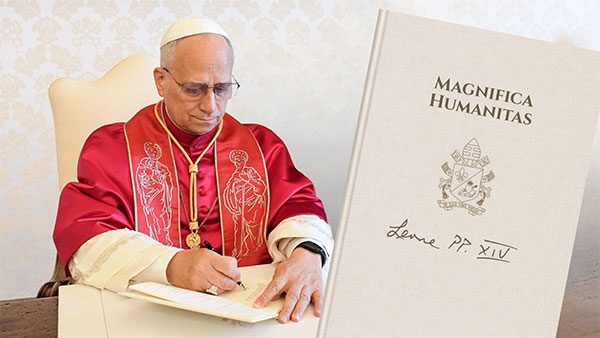
Although the world has embraced Artificial Intelligence usage,Pope Leo XIV has declared artificial intelligence one of the defining moral challenges of our time.
In his first encyclical: a formal letter intended to guide moral, social and theological thought. Titled Magnifica Humanitas (Magnificent Humanity), it argues that technology must serve humanity, rather than concentrate power or weaken human dignity.
“Technologies should serve humanity rather than reduce people to data, economic units or optimization problems,” he stated.
He builds on Pope Francis’ critique of “the tendency to let the logic of efficiency, control and profit alone shape personal, social and economic decisions,” in his 2015 encyclical. It, too, warned of the risks of technology.
The encyclical criticizes the use of AI in warfare, calling for imposing the “most rigorous ethical constraints” on weapons developed using AI. As governments invest heavily in autonomous military technologies and AI-assisted defence systems, the “growing ease” of deploying them makes war more likely and “less subject to human control”, it warns. This “violates the principle that armed force should be used only as a last resort in cases of legitimate self-defense.”


The letter also criticizes the growing concentration of technological power, and systems that reduce people to data or economic functions. It promotes what it calls a “civilization of love,” centred on human dignity, solidarity, truth, compassion and the common good.
Pope Leo’s response to the AI revolution deliberately references his predecessor Pope Leo XIII’s response to the problems of the Industrial Revolution, Rerum Novarum (“Of New Things”), in 1891. Though Magnifica Humanitas was released on May 25 2026, it is symbolically dated May 15, the date of Rerum Novarum.
An encyclical is not an ordinary papal statement. Traditionally addressed to bishops and the wider Catholic world, it is one of the Catholic church’s most authoritative teaching documents. The pope no longer has the direct political power the papacy held in the 19th century. But papal teaching still carries moral weight across a global Catholic network of schools, universities, charities, hospitals and community organisations.
For more than a century, Catholic social teaching has influenced public arguments about work, inequality, poverty, human dignity and the ethical limits of economic power. Although popes issued encyclicals long before the modern era, Rerum Novarum made social encyclicals globally influential. It confronted exploitative labour conditions, widening inequality, and conflict between workers and employers.
Pope Leo XIII defended workers’ rights and argued that wealth carried social responsibilities. The document influenced debates about labour rights and economic justice well beyond the church. In Australia in 1907, Justice H.B. Higgins drew on Rerum Novarum when establishing principles for a fair living wage. Pope Leo XIV’s encyclical attempts to do for the AI age what Rerum Novarum did for the industrial age: provide a moral framework for a technological transformation reshaping work, power and human relationships.
Pope Leo XIV argues moral responsibility can’t be transferred to automated systems, regardless of how sophisticated they become. He also rejects transhumanist ideas that human limitations should be technologically overcome, arguing vulnerability, dependence and imperfection are essential to being human. Relationships, care, solidarity and compassion are not weaknesses. “Humanity flourishes not despite limitations, but often through them.” Running throughout the encyclical is a contrast between a “culture of power” and a “civilization of love.” One treats technology primarily as a tool for domination and control. The other places human dignity, justice and care at the centre of social life.
The significance of Magnifica Humanitas lies in its ability to shape public conversation and moral imagination. Moral frameworks matter. They influence what societies fear, what they tolerate, what they defend – and what they refuse to sacrifice.
Pope Leo XIV’s intervention reminds us the central question is not whether AI will be powerful: it already is. The question is whether that power will be made answerable to human dignity. The future of AI will not just be decided in laboratories, boardrooms or parliaments. It will also be decided by the moral limits societies are willing to set. Pope Leo XIV’s encyclical is an attempt to draw those limits.
Meanwhile governments are investing in AI capability while still developing frameworks for transparency, accountability and safe deployment.
Schools and universities are rethinking assessment, authorship and learning through AI


