

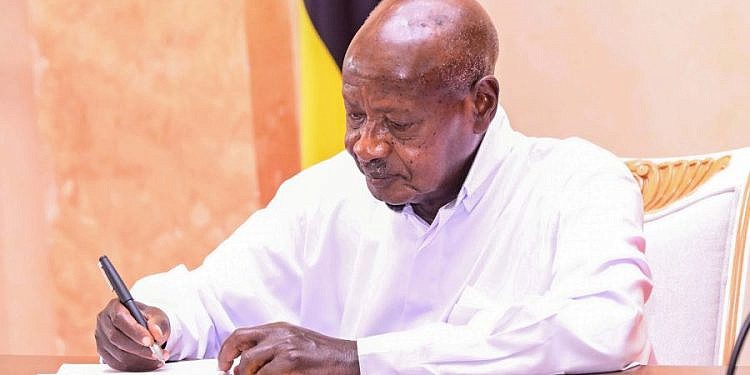
President Yoweri Kaguta Museveni has assented to the Protection of Sovereignty Bill, 2026, formally making it a law.
The new law is intended to provide for the protection of the sovereignty of the people of Uganda; designate the Department responsible for peace and security in the Ministry responsible for Internal Affairs as the
implementing authority; provide for the registration and regulation of agents of foreign entities; regulate funding and other forms of assistance to such agents; and for related matters.
With the Presidential assent, the Bill now becomes law and will guide implementation by the relevant state institutions in line with existing legal and policy frameworks.
The Protection of Sovereignty law is expected to strengthen Uganda’s capacity to safeguard its independence in national decision-making processes, while further entrenching the constitutional principle that governance and development priorities remain anchored in national interest. It is also anticipated to improve clarity in the management of state authority, enhance institutional coordination, and support ongoing efforts to promote stability, accountability, and orderly governance.
In addition, the law is seen as complementing Uganda’s broader development agenda, particularly in advancing economic transformation, improving public sector efficiency, and safeguarding national policy space as the country continues to engage with regional and international partners.
leader of Opposition jOESL senyonyi rejected the Protection of Sovereignty Bill, 2026 describing it as unnecessary, legally redundant and potentially harmful to Uganda’s democratic and economic environment.
The Leader of the Opposition (LoP), Hon. Joel Ssenyonyi while appearing before a joint committee scrutinising the Bill on Friday, 24 April 2026, said the proposed law duplicates provisions in statutes such as the Penal Code Act, Anti-Money Laundering Act, Public Finance Management Act and the NGO Act.
“We have a plethora of laws that touch critical concerns that anyone would have; the Penal Code Act captures a number of those provisions, so it is redundant,” Ssenyonyi said.
He explained that crimes such as treason, illicit financial flows and unlawful foreign funding are already criminalised under existing frameworks.
“If a foreign embassy tries to fund a violent coup, the Penal Code Act already criminalises treason. If someone launders illicit foreign money, the Anti-Money Laundering Act already mandates declarations of source of funds,” he added.
Ssenyonyi warned that the Bill introduces harsh provisions that could negatively affect Uganda’s economy and civic space.
He cited a clause capping foreign funding at Shs400 million where by receiving higher amounts without ministerial approval attracts penalties of up to 20 years in prison.
The LoP raised concern over Clause 2(2) which criminalises influencing the public against government policy, arguing that it undermines the constitutional role of the Opposition
