

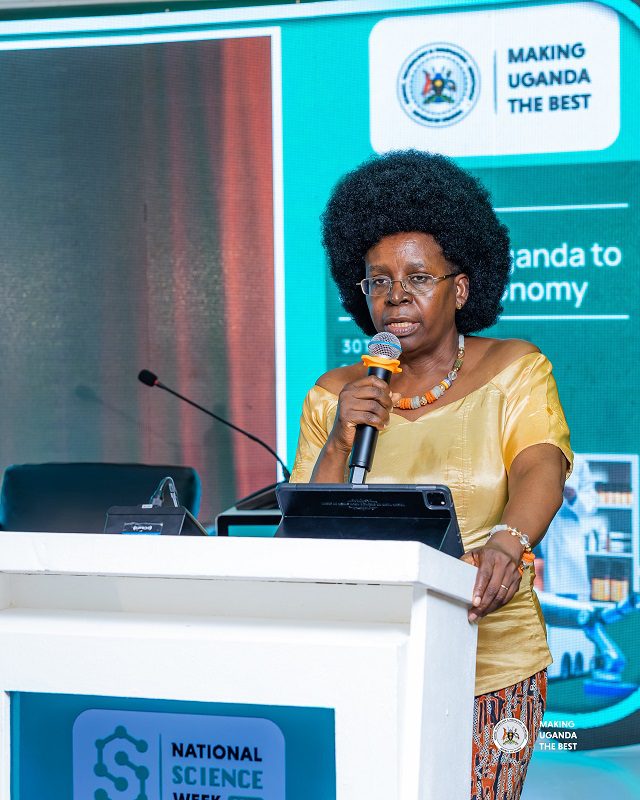
Science, Technology and Innovation Minister Monica Musenero has launched this years edition of National Science Week 2026 with major focus of growing the national economy to $500 billion.
The theme for the 2026 Uganda National Science Week (April 30 – May 3) is “STI Works :Powering Uganda to aUS500billon Economy,” focusing on leveraging science, technology, and innovation for economic growth. Other global 2026 science themes include “Curiosity: What’s your question?” (British Science Week) and “Seeds of Science: Nurturing Knowledge for All” (Australian Science Week)
According to the minister the three days event will focus on market-ready products and include investor round tables and global pitch sessions to connect local developers with international capital. rom April 30 to May 3 at Kololo Independence Grounds.
“The days ahead will see the opening of a hackathon to allow innovators hand in their innovations,” Musenero said during a launch event at the Serena Hotel in Kampala.
Musenero said Uganda is entering a results-driven phase, citing the recent 13,000-kilometer journey of the locally made Kayoola electric bus from Kampala to Cape Town as evidence of the country’s engineering capabilities.
Peter Ourien, undersecretary at the STI secretariat, said the department’s placement under the Office of the President reflects its role in job creation. He noted that while progress has been made, an investment gap remains as many investors still favor traditional sectors like real estate over innovation.
Partners for the event include Kiira Motors Corp. and the Uganda National Council for Science and technology.
Uganda is rapidly leveraging science, technology, and innovation (STI) to transition to a $500 billion economy by 2040,focusing on AI ,electronics manufacturing and agricultural technology . Key initiatives include building local capacity for electric mobility (Kayoola buses), deploying AI-driven solutions, and establishing innovation hubs to support startup.
The country is moving from importing technology to creating it, with a new DeepTech Centre in Namanve focusing on producing electronics like computers and drones.
Technology is used to boost agri-business through Artificial Intelligence, and local research institutes are producing innovations such as animal vaccines, organic fertilizers, and value-addition projects for crops like cassava.
Projects like the National Science, Technology, and Engineering Innovation Centre (NSTEIC) in Kiruhura and TIBIC in Namanve are being built to train engineers, graduates, and young people, strengthening the national innovation ecosystem.
Research institutes are working on human vaccine development and recycling plastic waste into useful materials like interlocking blocks
