

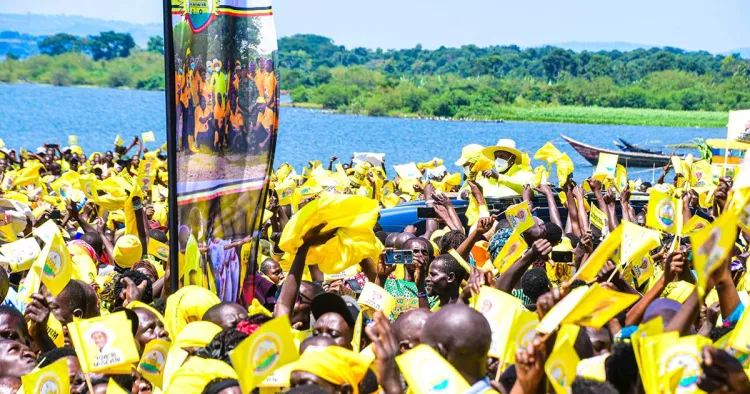
President Yoweri Museveni has announced firm plans to extend electricity to the island communities of Buvuma after many years off the national power grid.
Addressing a campaign rally at Kadinindi Playground, the President said government had already set the process in motion and instructed his aides to contact the Minister of Energy, Ruth Nankabirwa, to provide an update on the project.
Museveni explained that the electrification will be implemented in phases, beginning with the installation of solar-powered mini-grids to serve trading centres and smaller islands within the district. He said this phase is expected to be completed within six months.

“The first step is to roll out solar power using mini-grids to support business centres and the smaller islands,” Museveni said amid loud applause.
The second phase will involve connecting the main island to the national grid through an underwater power cable from Mayuge District, a project expected to be completed within a year.
Museveni also addressed concerns over compensation for residents who gave up land for oil palm cultivation. He assured locals that funds for compensation are available but emphasized the need for careful verification to determine rightful beneficiaries.
“We must clearly establish who qualifies for compensation and who does not. The money is available, but this must be handled correctly,” the President said.

NRM Vice Chairperson for Buganda, Haruna Kyeyune Kasolo, informed the President that Shs24 billion had already been released to compensate affected landowners.
The President further pledged to establish a ferry service linking Buvuma to Mayuge District to ease transportation, as well as set up boarding schools to support learners who struggle to move between islands.
He also committed to pushing for the creation of a second parliamentary constituency in the district.
Museveni urged residents to actively engage in income-generating activities, stressing that development must go hand in hand with wealth creation citing George Matongo from Ngoma in Nakaseke District, who, despite living far from paved roads, earns a steady income from dairy farming by selling 900 litres of milk daily, translating into about Shs21 million per month.
“The opportunity to escape poverty exists. Government programs are available, and many Ugandans have already benefited. You too can do the same,” Museveni said.
Around 9.5 to 10.5 million people in Uganda are estimated to have access to the national electricity grid as of late 2025, based on approximately 2.4 million connected households and an average of 4-4.5 people per household, though official figures for household connections hover around 2.3-2.4 million customers. The total number connected is increasing as projects expand access, with a goal to connect many more by 2027, but a large portion of Uganda’s population still relies on off-grid solutions.