


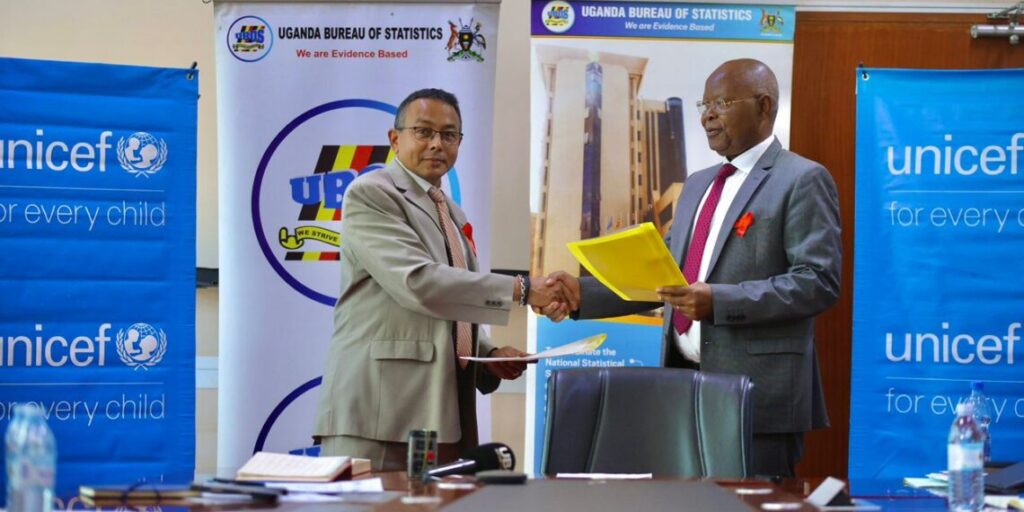
Uganda Bureau of Statistics (UBOS) and UNICEF have signed a Memorandum of Understanding in which the former will conduct first-ever Multi-Indicator Cluster Survey (MICS) for children in the financial year 2026/27.
In his remarks UBOS Executive Director Dr. Chris Mukiza said the new MICS UNICEF’s flagship global household survey programmes is expected to replicate and even expand elements traditionally captured under the Demographic Health Survey.


“The multi-indicator cluster survey will have all elements required in the new DHS. You may not need to do an independent DHS,” Dr. Mukiza said, describing the development as “good news” for UNICEF and government planners.
He further said that the survey marks a critical step in building a stronger, evidence-based foundation for tackling child poverty and guiding national development priorities.
“Because UNICEF’s main calling is on children, we have worked together on many products including the child poverty report produced six years ago and we continue to produce similar evidence,” Mukiza stated.
Dr Mukiza applauded UNICEF for years of technical and financial support, including work on the Demographic and Health Survey (DHS) and other statistical studies, noting that the organisation has been instrumental in bridging funding gaps left by the Government of Uganda.


He however noted that Government of Uganda–UN Joint Programme on Data and Statistics, which has been running since 2023, is due to end in 2025 hence tasked its internal technical committee to evaluate the programme’s achievements and propose a successor initiative.
“All financial and technical operations between the UN family and UBOS are anchored on this joint programme. We must review what has been achieved, what remains, and how we draw up a successor programme,” Dr Mukiza stressed.
UNICEF Uganda Country Representative Dr. Robin Nandy said the 2026/27 MICS comes at a decisive moment, as Uganda and the world approach the final five years of the Sustainable Development Goals (SDGs).
“This is more than the formalisation of an agreement. It is a powerful testament to our shared vision—UNICEF and UBOS for evidence-based decision-making, accountability, and meaningful progress for every child in Uganda,” Dr. Nandy said.


He noted that MICS surveys have been conducted in over 120 countries, with more than 400 completed since the 1990s, and are globally regarded for providing statistically sound, comparable data on children and women.
“This is the first time Uganda is embarking on a MICS survey. The data will complement the last DHS conducted in 2022 and will inform national strategies, empower communities, and guide partners on where resources are needed most—particularly for the most vulnerable children,” he added.
Dr. Nandy emphasized that the MICS will be essential in monitoring Uganda’s progress under the National Development Plan IV, the SDGs, and commitments under the Convention on the Rights of the Child.
According to Nandy,the MOU signed between UBOS and UNICEF will also address long-standing technical and financial gaps that have affected large-scale national surveys.
However UNICEF will also partner with UBOS on a Violence Against Children Survey (VACS) to enrish stakeholders engagement to generate quality data survey:
“Behind each statistic is a human story a child who deserves to grow up healthy and educated, a mother seeking safe water and nutrition for her family, a community aspiring for a brighter future.”Nandy stated.
He reaffirmed UNICEF’s commitment to provide both technical and financial support to ensure the MICS meets the highest standards of quality and integrity.
The 2026/27 MICS is expected to deliver the most comprehensive picture to date of the wellbeing of Uganda’s children and women, enabling government, civil society, and development partners to better target interventions and close persistent gaps.


UNICEF and the Uganda Bureau of Statistics (UBOS) have a longstanding and extensive collaboration focused on generating quality data and statistics, particularly concerning the well-being of children and women in Uganda. Their partnership involves technical, financial, and logistical support for major national surveys and the development of innovative data collection tools
Key Areas of Collaboration
- UNICEF is a key partner providing funding and technical support for multiple iterations of the Uganda Demographic Health Survey, including the most recent 2022 survey. This survey is crucial for gathering data on demographics, family planning, maternal and child mortality, and healthcare service access.
- UNICEF has also partnered with UBOS to develop and implement uSurvey, an open-source, web-based mobile data collection tool. This innovation has enhanced the timely release of survey results, increased data collection frequency, and saved time and money by replacing paper questionnaires. UBOS has since taken full ownership of the tool.
- the two entities collaboration extends to producing in-depth thematic reports, such as the Thematic Report on Adolescents and Youths in Uganda, which uses consolidated UDHS data to inform policy and advocacy efforts.
- UBOS works within UNICEF’s global MICS program, which sets the standard for monitoring indicators related to children’s and women’s situations worldwide.
- UNICEF is one of the 12 UN agencies that launched a joint program with the Government of Uganda and UBOS to strengthen the national statistical system, improve data production and reporting, and support evidence-based decision-making across various sectors.
- lastly In 2025, the partnership is set to produce new reports on monetary and multidimensional child poverty statistics and a child census report. This robust collaboration ensures that reliable, high-quality, and disaggregated data is available to inform national planning, policy formulation, and the monitoring of progress toward the Sustainable Development Goals (SDGs).