


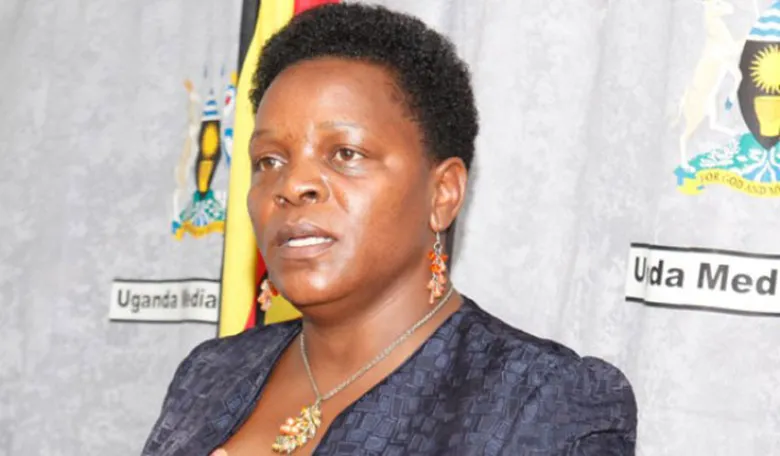
Uganda will next week launch Self Reliance index tool that will be used by government and Development partners to measure refugee programmes impact,the Minister of State for Gender and Culture, Hon. Dr. Peace Regis Mutuuzo has revealed.
Uganda is home to the largest refugee populations in Africa, and World Food Programme plays a crucial role in supporting these communities.


“Our goal has always been to align with the government’s priorities, making sure our efforts support national strategies. Our work is guided by the Government’s policies and the Comprehensive Refugee Response Framework (CRRF). We provide life-saving food and nutrition assistance and initiatives that promote livelihoods and resilience,”UN World Food Programme Head of Programme Ms Genevieve Chicoine said.
“By promoting and diversifying livelihoods, we work with partners to help refugees and host communities move from dependency to self-reliance.,”she stated,
Genevieve reaffirmed WFP commitment to supporting uganda government and partners in operationalizing the index saying this tool will establish standards for unified monitoring and reporting of programs contributing to self-reliance.


She encouraged all partners to adopt and use the Uganda Self-Reliance Index adding that It is a government-led, evidence-based tool that will strengthen programming and accountability for results.
“I extend our deepest appreciation to the Government of Uganda for its leadership, and to all partners who contributed to this milestone. Together, we are advancing a shared vision of resilience and dignity for refugees and host communities in Uganda,”she stated.
Mutuuzo told the media that promoting self-reliance is at the heart of Uganda’s refugee response however, measuring it accurately has been a challenge.
“There were gaps in standardized indicators and tools. Partners used various project-specific tools, but these lacked comparability. This created an urgent need for a government-led, standardized measurement framework,”she stated.


At the Global Refugee Forum 2023 in Geneva, the Government of Uganda pledged to develop national minimum standard indicators for measuring self-reliance of refugees and host communities. This was a bold and visionary commitment to strengthen accountability.
To support this pledge, WFP made a matching commitment to provide both technical and financial assistance. WFP co-chaired the Self-Reliance Reference Group, which brought together government ministries, departments, agencies, and partners to drive this process forward.
From 2023 to date, the process has involved multiple stakeholders and sector working groups. Together, we supported the government to produce a robust National Self-Reliance Measurement Framework.
The Uganda Self-Reliance Index (UG-SRI) is the tool that will be used by Government and Development partners to measure Self-Reliance. For example, imagine two NGOs: one working in West Nile and another in the South West. Both organizations implement livelihood programmes for refugees and host communities. While both aim to promote self-reliance, each NGO might use its own set of indicators to measure success.


Without a harmonised tool, it becomes difficult to compare results or truly understand whether participants are becoming self-reliant across interventions and locations.
“As a government-led, unified tool, it ensures that all partners are measuring the same outcomes, allowing for accurate assessment of progress and better accountability for results,”Mutuuzo explained.