

President Yoweri Kaguta Museveni has re-emphasized the seven pillars of the National Resistance Movement (NRM) manifesto, which include peace, development, wealth creation, job generation, service delivery, markets, and regional political federation as the foundation for Uganda’s continued progress and unity.
Museveni said the NRM’s manifesto represents four decades of tangible contributions that have transformed Uganda from instability to a country of peace, development, and economic recovery.


“This group, which is now called NRM, crystallized around 1965 from the old political parties – DP, UPC, and Kabaka Yekka -because of ideology. Those groups were emphasizing identity, religion, and tribe, and they didn’t want to talk about women. Women didn’t matter. But we said, no, that is not the way forward,” President Museveni said, while tracing the ideological roots of the NRM.
“We don’t look at who you are, but at what you do. That’s what guides us. Because of that, we’ve been able to build a national political party and institutions like the army, which have kept Uganda peaceful,” he said.
“Peace was achieved because we built institutions based on logic, not emotion. In Karamoja alone, we removed 41,000 illegal guns. That’s why peace remains our number one contribution,” he added.
The second pillar of the NRM manifesto, President Museveni said, is development, particularly in the area of infrastructure and social services. He noted that the NRM government has invested heavily in expanding road networks, constructing schools, hospitals, and
other social infrastructure, which have collectively improved Uganda’s economic base and connectivity.

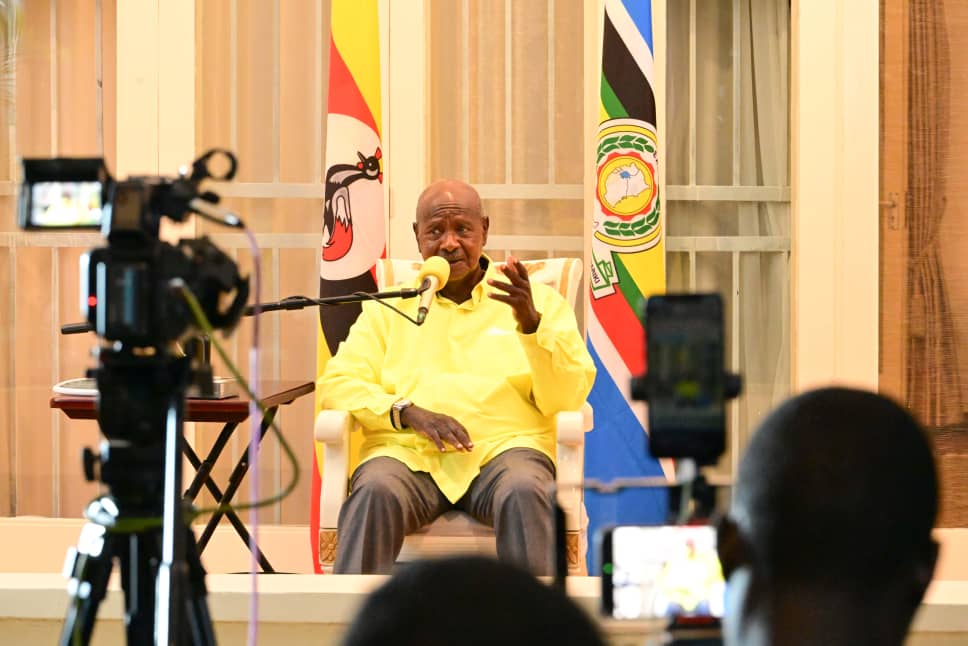
“Development is the second key contribution. We have worked on roads, schools, hospitals, and all infrastructure that supports both economic and social progress,” President Museveni said.
Highlighting the third point in the NRM manifesto, the President emphasized the centrality of wealth creation as the most dynamic component of Uganda’s economic transformation.
He explained that the NRM government’s economic philosophy promotes household-level prosperity, urging every family to engage in productive enterprises that generate income.
“We don’t believe in a culture of poverty. Every home must have wealth. Before colonialism, there was no unemployment. People had families of blacksmiths, carpenters, and artisans; everyone was productive. Unemployment is a colonial phenomenon,” H.E.Museveni said, citing the Emyooga initiative as a revival of Uganda’s traditional specialization system, enabling skilled individuals such as carpenters, welders, tailors, and farmers to create wealth and contribute to national income.


The President underscored that wealth creation is the cornerstone of a self-sustaining economy, explaining that taxes and government revenues originate from citizens’ consumption and productivity.
“If I have cows and sell them, I provide beef and milk for the country, but I also earn money and build a good house. That house contributes taxes through the cement used. So, wealth benefits the individual and the nation,” he noted.
President Museveni commended the people of Sebei for their hardworking nature but urged them to engage in fast-return enterprises to increase cash flow and investment capacity.
“Our people cultivate maize, which takes eight to nine months to mature. We encourage them to go for enterprises that bring quick returns. We have moved from 32% to 67% of Ugandans in the money economy, but we must bring the remaining 33% on board,” he added.
Regarding job creation as the fourth point of the NRM manifesto, President Museveni cautioned that job opportunities cannot be created in isolation from wealth and production. He criticized the misconception that jobs are a government-provided resource, saying the public sector alone cannot absorb Uganda’s growing labor force.
“Government jobs are only 480,000 against a population of 50 million, which will be 100 million in 30 years. So where will jobs come from? Jobs in modern society come from commercial agriculture, manufacturing, services, and ICT,” he explained.


The President reiterated that the NRM’s approach links job creation directly to wealth generation, industrialization, and innovation, emphasizing that entrepreneurship and private investment are the primary engines for sustainable employment.
The fifth point in the manifesto, President Museveni said, is strengthening service delivery across key sectors such as education, health, and governance.
He acknowledged ongoing challenges in healthcare and education but maintained that the government has built the necessary foundation to sustain progress in these sectors.
“Service delivery involves all the essential areas: education, health, security, governance, and entertainment. We are addressing these continuously,” he said.
On the sixth pillar, the President addressed the issue of markets, stressing that Uganda’s production levels have now outgrown domestic consumption capacity.
“Everything we are producing – sugar, cement, milk, bananas – is in surplus. The internal market is not enough. We need a regional market,” he said.
He criticized sections of the political class for focusing on elections and power instead of discussing strategic economic issues such as market access and trade integration.
“Our politicians talk about power, not markets. But what are you going to do with power if you don’t have a market for your people’s products?” he asked.
He explained that economic integration within the East African Community (EAC) is essential to address the surplus production and ensure sustainable industrial growth.
The seventh and final pillar in the NRM manifesto, President Museveni said, is the pursuit of political federation in East Africa, aimed at creating a unified bloc capable of addressing regional economic and security challenges.
“If there were a Federation in East Africa, we would have a center of gravity for Africans and the black race. The Americans, Russians, and Chinese are exploring space while Africa still remains divided. A political Federation would strengthen our strategic security,” he emphasized.